In the paper
Evolutionary Biology is worth 3 marks, and Evidences of evolution is its most reliable source of a question, because every item can be built around a named example. The MEC scope line lists five kinds: Morphological, Anatomical, Paleontological, Embryological, Biochemical. Typical angles:
- Recall — which organ is vestigial in humans, which fossil links reptiles and birds, who proposed the biogenetic law.
- Understanding — homologous versus analogous (same origin or same function?), why analogous organs point to convergent evolution, why an embryo's gill slits are evidence.
- Application — a described pair of organs to classify; a fossil sequence to read; amino-acid differences to rank species by relatedness.
Morphological
Comparative morphology compares the form and plan of organs across groups.
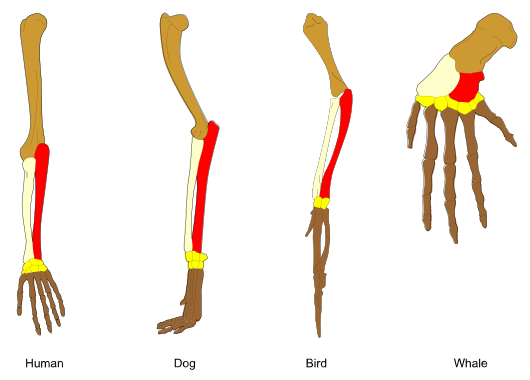
Homologous organs share the same embryonic origin and basic structure but may do different jobs. The textbook case is the pentadactyl forelimb: the human arm, the bat wing, the whale flipper, the horse foreleg and the frog forelimb are all built on humerus – radius/ulna – carpals – metacarpals – phalanges. Same blueprint, different use, because each lineage was modified from one tetrapod ancestor. Homology is evidence of divergent evolution (adaptive radiation). Richard Owen defined the term in 1843, before Darwin explained it.
Figure 1 Homologous forelimbs: human, dog, bird and whale
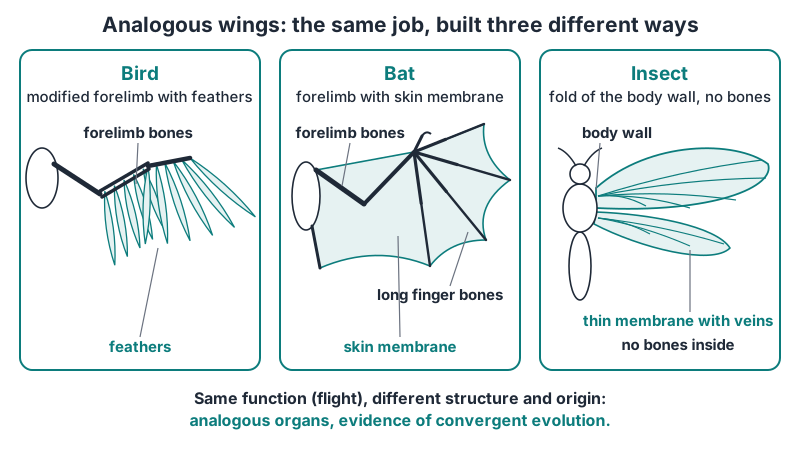
Analogous organs do the same job but are built differently from different origins: the wings of a bird (modified forelimb with feathers), a bat (forelimb with skin membrane) and an insect (fold of the body wall, no bones); the eyes of an octopus and a vertebrate; the fins of a fish and the flippers of a whale. Analogy is evidence of convergent evolution — unrelated groups arriving at similar solutions to the same environmental problem.
Figure 2 Analogous wings of a bird, a bat and an insect
Same origin, different function = homologous = divergent. Different origin, same function = analogous = convergent. Most morphological questions are this one distinction in disguise.
Anatomical
Comparative anatomy looks inside and finds structures that make sense only as leftovers or bridges.
Vestigial organs are reduced, functionless remnants of organs that worked in ancestors. Wiedersheim listed 86 in humans in 1893 (later lists reach about 180). The ones MEC expects:
| Human vestige | Functional in |
|---|---|
| Vermiform appendix | Herbivores (cellulose digestion, caecum) |
| Coccyx (tail vertebrae) | Tailed mammals |
| Plica semilunaris | Nictitating membrane (third eyelid) of birds and reptiles |
| Wisdom teeth (third molars) | Ancestors with larger jaws |
| Auricular (ear) muscles | Mammals that turn the pinna |
| Body hair and the goose-bump reflex | Fur-bearing ancestors (insulation, threat display) |
| Nipples in males | — (developmental) |
Animal examples: hind-limb bones buried in a whale, the paired spurs of a python, the tiny wings of the kiwi, the eyes of blind cave fish.
Atavism is the reverse: the rare reappearance of an ancestral feature — a baby born with a short tail, extra nipples or dense body hair — showing the genes are still present but normally silent.
Connecting links are living animals that carry the characters of two groups and so bridge them:
| Connecting link | Between | Why |
|---|---|---|
| Euglena | Plants and animals | Chloroplasts yet motile with a flagellum |
| Peripatus | Annelida and Arthropoda | Segmented, soft, unjointed legs (annelid); tracheae, chitin claws, haemocoel (arthropod) |
| Balanoglossus | Non-chordates and chordates | Pharyngeal gill slits, a buccal diverticulum once called a notochord |
| Lungfish (Neoceratodus, Protopterus) | Fishes and Amphibia | Gills plus lungs, internal nostrils |
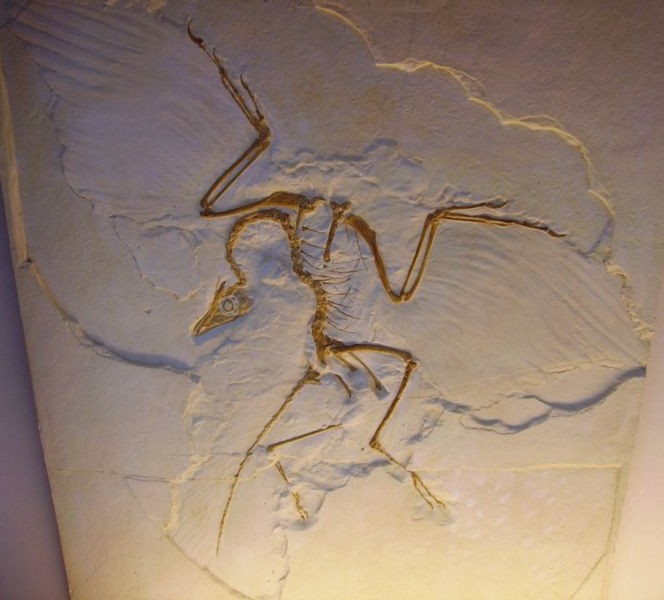
| Archaeopteryx (fossil) | Reptiles and Birds | Teeth, long bony tail, clawed fingers; feathers, wings, wishbone |
| Duck-billed platypus (Ornithorhynchus) | Reptiles and Mammals | Lays eggs, has a cloaca and an interclavicle; fur and milk |
Paleontological
A fossil is any preserved remain or trace of a past organism in sedimentary rock — bones, shells, moulds and casts, impressions, insects in amber, petrified wood, coprolites and footprints. Palaeontology is the only direct record of evolution.
Dating fossils. Relative dating uses the law of superposition: deeper strata are older. Absolute dating uses radioactive decay. Radiocarbon dating (Libby, late 1940s) relies on carbon-14, half-life about 5,700 years (5,730 in most textbooks), and works only to about 50,000 years. Older rocks are dated by potassium–argon or uranium–lead decay, which run to billions of years.
What the record shows.
- Succession. Older strata hold simpler forms: invertebrates before fishes, fishes before amphibians, then reptiles, then mammals and birds.
- Missing links. Archaeopteryx — Late Jurassic, about 150 million years old, from the Solnhofen limestone of Bavaria, Germany, first described by Hermann von Meyer in 1861, two years after the Origin.
- Phylogenetic series. The horse: Eohippus (Hyracotherium, Eocene, about 55 million years ago, fox-sized, four toes on the forefoot and three behind, low-crowned browsing teeth) → Mesohippus (Oligocene, three toes) → Merychippus (Miocene, three toes but weight on the middle one, high-crowned grazing molars) → Pliohippus (Pliocene, one toe) → Equus (Pleistocene onwards). Trends: larger body, longer legs, fewer toes ending in one hoof, taller grinding teeth as forest gave way to grassland.
- Living fossils — species almost unchanged for tens of millions of years: the coelacanth Latimeria (rediscovered 1938), the king crab Limulus, the tuatara Sphenodon and the plant Ginkgo.
Figure 3 Fossil of Archaeopteryx
Embryological
von Baer's laws (1828) came first: general characters of a group appear in the embryo before special ones, and the embryo of a higher animal resembles the embryo, never the adult, of a lower one. The early embryos of a fish, a frog, a chick, a rabbit and a human are hard to tell apart.
Haeckel's biogenetic law (1866) — ontogeny recapitulates phylogeny, "an individual's development repeats the evolutionary history of its race" — pushed the idea further. The evidence is the shared vertebrate plan: every vertebrate embryo, including the human, passes through a stage with a notochord, a dorsal hollow nerve cord, pharyngeal gill slits (pouches) and a post-anal tail. Human gill pouches never breathe; they are remodelled into the ear canal, tonsils, parathyroid and thymus, and the tail is absorbed before birth. A frog tadpole makes the same point: a fish-like larva with gills becomes a lunged, four-legged adult.
Haeckel's strong claim is not accepted today — embryos resemble ancestral embryos, not ancestral adults (which is exactly von Baer's point) — so an option that says a human embryo "passes through an adult fish stage" is wrong.
Biochemical
The biochemical (molecular) evidences are the youngest and the strongest.
- Universal molecules. All cells use DNA and RNA with the same bases, the same triplet genetic code, the same 20 L-amino acids, ATP and the same enzymes of glycolysis — far easier to explain by common descent than by separate origins.
- Protein sequence comparison. Cytochrome c, a respiratory-chain protein of 104 amino acids in most vertebrates, is the classic marker. Human and chimpanzee cytochrome c are identical; the rhesus monkey differs by one amino acid, the horse by about twelve, yeast by more than forty. The number of differences ranks species by relatedness, matching the fossil tree. Haemoglobin tells the same story.
- DNA hybridisation. Single strands of DNA from two species are mixed; the more base pairs they share, the more stable the hybrid and the higher the temperature needed to separate it. Human–chimpanzee DNA differs by little more than one per cent.
- Serological (precipitin) test (Nuttall, 1904). Antiserum raised against human blood proteins precipitates most strongly with human serum, less with chimpanzee and monkey sera, still less with other mammals — antigenic similarity falls with evolutionary distance.
Numbers and names to memorise
| Item | Value or name |
|---|---|
| Term homology defined | Richard Owen, 1843 |
| Human vestigial organs (Wiedersheim, 1893) | 86, later lists about 180 |
| Archaeopteryx | About 150 Ma, Late Jurassic, Solnhofen, Germany; described 1861 |
| Eohippus (Hyracotherium) | Eocene, about 55 Ma, four front toes, fox-sized |
| Carbon-14 half-life and range | About 5,700 (textbooks 5,730) years; up to about 50,000 years |
| Latimeria rediscovered | 1938 |
| von Baer's laws | 1828 |
| Biogenetic law | Haeckel, 1866 — ontogeny recapitulates phylogeny |
| Cytochrome c | 104 amino acids; human = chimpanzee; rhesus differs by 1 |
| Precipitin test | Nuttall, 1904 |
| Human–chimpanzee DNA difference | Little more than 1 per cent |
Traps
- Homologous means same origin, not same function. A whale flipper and a bat wing are homologous even though one swims and one flies. Bat and insect wings are analogous even though both fly.
- Divergent goes with homologous; convergent with analogous. Swapping these is the commonest error in the unit.
- Vestigial is not atavistic. A vestige is present in everyone and useless; an atavism is a rare throwback (a baby with a tail).
- Archaeopteryx is a fossil link; Peripatus and the platypus are living links. A question on "living connecting link between reptiles and mammals" wants the platypus, not Archaeopteryx.
- Balanoglossus bridges non-chordates and chordates (a hemichordate); Peripatus annelids and arthropods; Euglena plants and animals. Match the pair, not just the name.
- Carbon dating cannot date dinosaurs. Its ceiling is about 50,000 years; anything older needs potassium–argon or uranium series.
- Haeckel versus von Baer. Haeckel says embryos repeat ancestral adults (rejected); von Baer says embryos resemble ancestral embryos (accepted).
Quick check
0 of 5 answered- 1The forelimb of a bat and the flipper of a whale are:
- 2Which human structure is the remnant of the nictitating membrane?
- 3A geologist recovers a bone she believes is 2 million years old. Radiocarbon dating is unsuitable because:
- 4Ontogeny recapitulates phylogeny is the biogenetic law proposed by:
- 5Cytochrome c from four animals differs from the human sequence by 0, 1, 12 and 44 amino acids. Which animal is the 44?
Sources
- OpenStax Biology 2e, ch. 18.1 Understanding Evolution (fossils, homologous and vestigial structures, analogous wings, embryology, biogeography, DNA universality) — consulted.
- Wikipedia: Homology (biology), Vestigiality, Archaeopteryx, Evolution of the horse, Living fossil, Radiocarbon dating, Karl Ernst von Baer, Recapitulation theory, Onychophora, Platypus, Cytochrome c — dates, ages and example features; consulted, own words.
- NCERT Class 12 Biology, ch. 7 Evolution (scope and the set of examples) — consult only.
- Nepal CDC Grade 12 Biology, Zoology unit Evolutionary Biology — terminology, the five-way split used as headings.
- Figures: credited in each caption (Wikimedia Commons, OpenStax, original diagrams).