In the paper
Evolutionary Biology carries 3 marks of the 40 Zoology marks in MECEE-BL, and with four chapters sharing them, Origin of life averages under one (MEC publishes weights by unit, not by chapter). The MEC scope line is short: Oparin–Haldane theory; Miller–Urey experiment. The same two ideas are asked three ways:
- Recall — which gas was absent from the primitive atmosphere, who said "hot dilute soup", which year, which products came out of the flask.
- Understanding — why a reducing atmosphere matters, why free oxygen would have wrecked the process, why the spark and the condenser are both essential parts of the apparatus.
- Application — a described variation of the experiment ("Miller's set-up with oxygen added; predict the result") or steps of chemical evolution to put in order.
Oparin–Haldane theory
What came before. Aristotle's spontaneous generation (frogs from mud, maggots from meat) was dismantled by Redi (1668), Spallanzani (1765) and finally Louis Pasteur's swan-necked flasks (1862). Pasteur's conclusion, biogenesis ("life from pre-existing life"), left a gap: if every cell comes from a cell, where did the first cell come from? Panspermia (Richter, Arrhenius) only moved the question to another planet.
The proposal. The Russian biochemist A. I. Oparin (1924) and the British geneticist J. B. S. Haldane (1929) answered independently and almost identically: the first cell was assembled gradually from non-living chemicals under conditions that no longer exist on Earth. This is chemical evolution, also called the modern theory of abiogenesis — the word now means "chemical origin" rather than "frogs from mud", a common exam trap.
The conditions they assumed.
- The primitive atmosphere was reducing: methane (CH4), ammonia (NH3), hydrogen (H2) and water vapour (H2O), with no free oxygen. Oxygen is a chemical vandal — it would have oxidised any organic molecule as fast as it formed, so its absence is the single most important condition.
- Energy was abundant: ultraviolet light (no ozone screen yet), lightning, volcanic heat and radioactivity.
- The Earth had cooled enough for water vapour to condense into hot, shallow seas.
The steps, in order. Examiners like this as a sequencing question, so learn the order:
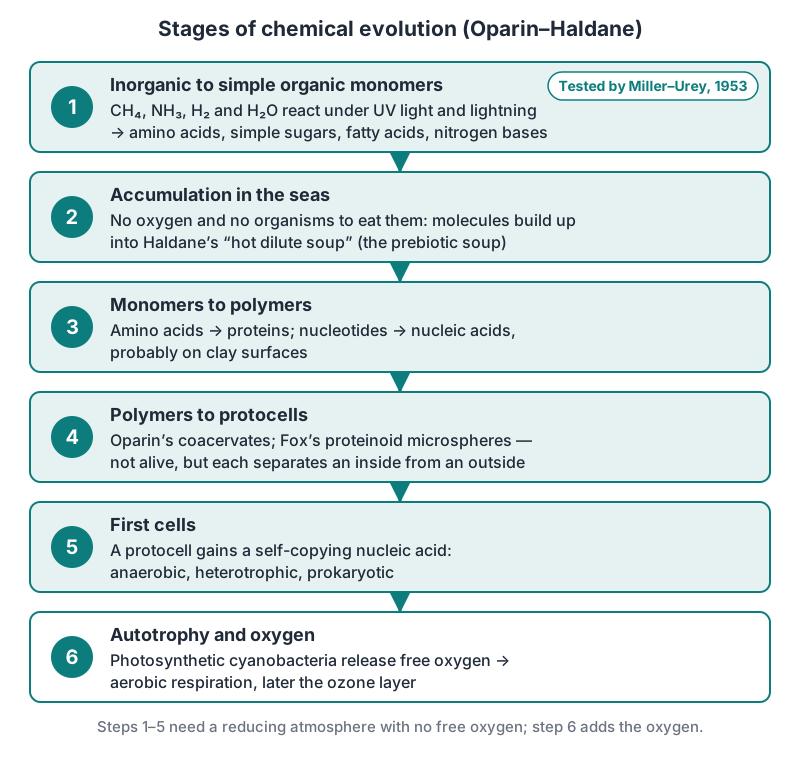
- Inorganic to simple organic monomers — CH4, NH3, H2 and H2O reacted under UV and lightning to give amino acids, simple sugars, fatty acids and nitrogen bases.
- Accumulation in the seas — with no oxygen and no organisms to eat them, these molecules built up over millions of years into Haldane's "hot dilute soup" (the prebiotic or primordial soup).
- Monomers to polymers — amino acids joined into proteins and nucleotides into nucleic acids, probably on clay surfaces.
- Polymers to protocells — polymers gathered into bounded droplets. Oparin called them coacervates (colloidal droplets of protein and polysaccharide that grow and split); Sidney Fox later made proteinoid microspheres by heating amino acids. Neither is alive, but each separates an inside from an outside.
- First cells — a protocell that gained a self-copying nucleic acid became the first true cell: anaerobic, heterotrophic, prokaryotic, feeding on the soup around it.
- Autotrophy and oxygen — as the soup ran out, photosynthetic prokaryotes (cyanobacteria) appeared and slowly oxygenated the atmosphere, allowing aerobic respiration and, later, the ozone layer.
Figure 1 Stages of chemical evolution according to Oparin and Haldane
The timescale. The Earth formed about 4.5 billion years ago (4.54 Ga in OpenStax and Wikipedia; many school books round to 4.6). The oldest microbial mats and stromatolites are about 3.5 billion years old, with chemical traces perhaps as old as 3.8 billion years — so cellular life took roughly a billion years to appear.
Why it is only a theory of the possible, not a record of what happened. Oparin and Haldane could show that the steps were chemically plausible; they could not show they did occur. That is exactly the gap Miller and Urey set out to close for step 1.
Miller–Urey experiment
Who and when. Stanley Miller, a graduate student at the University of Chicago, built the apparatus in 1952 under his supervisor Harold Urey (a Nobel laureate who kept his name off the paper). The result was published in Science in 1953 — the year to remember.
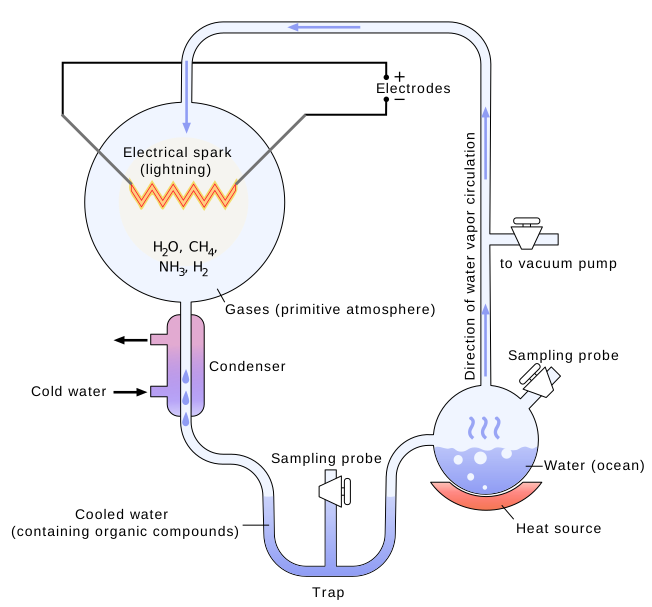
The apparatus. Picture two glass flasks joined into a closed loop:
- A small flask of water, heated so it boils — this is the "primitive ocean" supplying water vapour.
- A large 5-litre flask containing the gas mixture: CH4, NH3 and H2 in the ratio 2:2:1, plus the water vapour rising from below — this is the "primitive atmosphere".
- Two tungsten electrodes in the large flask giving a continuous electric spark — the "lightning".
- A condenser that cools the gases so that anything formed dissolves in droplets and drains through a U-shaped trap back to the water flask — the "rain" — and round again.
Figure 2 The Miller–Urey apparatus
What happened. After a week of continuous circulation the water turned deep red-brown. Miller analysed it by paper chromatography and found amino acids — glycine, alanine (alpha and beta forms), aspartic acid and alpha-aminobutyric acid — plus simpler organics such as urea, formic acid and hydrogen cyanide (an intermediate on the route to amino acids). No cells, no proteins and no nucleic acids: the experiment proved step 1 of chemical evolution, nothing more. When Miller's stored vials were re-examined by mass spectrometry in 2008, more than twenty amino acids were detected.
Why each part matters — the understanding questions.
- Why no oxygen? Replace the hydrogen with oxygen and the yield of amino acids collapses, because organic products are oxidised and the spark drives combustion instead of synthesis. This is the standard "predict what happens if" item.
- Why a closed system? To exclude modern air and living contaminants, so any amino acid found must have been made abiotically inside the loop.
- Why the condenser? Products left in the spark zone are broken down again; condensing and trapping them mimics rain washing molecules into the sea, where they accumulate.
- Why does it support Oparin–Haldane? The raw materials Oparin assumed can be made in days from a reducing gas mixture and lightning — the first experimental support for chemical evolution.
What it does not show. Geochemists now think the earliest atmosphere was only weakly reducing (more CO2 and N2, less CH4 and NH3); Miller's later runs with such mixtures still gave amino acids, though fewer. For the paper, the flask, the four gases, the spark and the amino acids are what is examined.
Numbers and names to memorise
| Item | Value or name |
|---|---|
| Age of the Earth | About 4.5 billion years (4.54 Ga; school texts often 4.6) |
| Oldest fossil evidence of life (stromatolites) | About 3.5 billion years |
| Pasteur's swan-necked flask | 1862, establishes biogenesis |
| Oparin | Russian biochemist, 1924, coacervates |
| Haldane | British scientist, 1929, "hot dilute soup" |
| Primitive atmosphere | CH4, NH3, H2, H2O — reducing, no free O2 |
| Miller–Urey experiment | Built 1952, published 1953, University of Chicago |
| Gas ratio in the flask | CH4 : NH3 : H2 = 2 : 2 : 1, plus water vapour |
| Energy source in the flask | Electric spark between tungsten electrodes (lightning) |
| Duration | One week of continuous circulation |
| Main products | Amino acids — glycine, alanine, aspartic acid |
| Fox | Proteinoid microspheres, 1950s–60s |
| First cells | Anaerobic, heterotrophic prokaryotes |
Traps
- Abiogenesis has two meanings. Aristotle's abiogenesis (life from mud, disproved by Pasteur) and the modern abiogenesis of Oparin–Haldane (slow chemical evolution) share a name. A question that says "abiogenesis was disproved by Pasteur" refers to the old one.
- Oparin 1924, Haldane 1929 — five years apart, Oparin first. "Hot dilute soup" is Haldane's phrase, coacervate is Oparin's.
- Hydrogen, not oxygen. The four Miller gases are CH4, NH3, H2 and H2O. Oxygen and CO2 were not in the original flask.
- Amino acids, not proteins. Miller made monomers only. Any option saying he produced proteins, nucleic acids or cells is wrong. School texts quote a flask temperature of about 800 °C; the original paper reports only the spark and boiling water.
- The first cells were heterotrophs, not autotrophs — they ate the soup. Photosynthesis, oxygen and aerobic respiration came later, in that order.
- Biogenesis is Pasteur's word, and it describes how life continues today; it does not explain how life began. Do not pick "biogenesis" as the theory of origin of life.
Quick check
0 of 5 answered- 1Which gas was deliberately excluded from the primitive-atmosphere mixture in the Miller–Urey apparatus?
- 2The phrase "hot dilute soup" for the prebiotic ocean is credited to:
- 3A student repeats the Miller–Urey run but removes the condenser and trap, keeping the spark going. Compared with the original, the most likely outcome is:
- 4Which sequence correctly orders the stages of chemical evolution?
- 5The earliest cells on Earth are believed to have been:
Sources
- OpenStax Biology 2e, ch. 22.1 Prokaryotic Diversity (age of the Earth, anoxic early atmosphere, stromatolites, oxygenation by cyanobacteria) — consulted.
- Wikipedia, Abiogenesis (Oparin 1924, Haldane 1929, "hot dilute soup", reducing versus weakly reducing atmosphere, Earth 4.54 Ga, life by 3.5–3.8 Ga) — consulted, own words.
- Wikipedia, Miller–Urey experiment (1952 apparatus, 1953 Science paper, gas ratio 2:2:1, one-week run, amino acids identified, 2008 reanalysis, Urey's role) — consulted, own words.
- NCERT Class 12 Biology, ch. 7 Evolution (scope and depth; the 800 °C figure quoted in school texts) — consult only.
- Nepal CDC Grade 12 Biology, Zoology unit Evolutionary Biology — terminology and depth.
- Figures: credited in each caption (Wikimedia Commons, OpenStax, original diagrams).