In the paper
Unit 1 carries 17 of the 50 chemistry marks; with fourteen chapters sharing them, this one averages a little over one (MEC publishes weights by unit, not by chapter). Its real value is larger than its share: the radical charges, the mass scale and the empirical-formula routine are assumed by Stoichiometry, Volumetric analysis and every formula you write all paper.
The MEC scope line runs: Atoms, molecules and valency; relative atomic mass and molecular mass, atomic mass unit; radicals; molecular formula, empirical formula and chemical equations; percentage composition. The headings below are its points, in MEC's order.
Three ways it comes: recall (the charge on dichromate, what one amu is defined against, the atomicity of phosphorus); understanding (why an empirical formula alone can never fix a molecular formula, why NaCl has a formula mass and not a molecular mass); application (turn a percentage composition plus a vapour density into a molecular formula, or a fertiliser formula into its nitrogen percentage).
Atoms, molecules and valency
An atom is the smallest particle of an element that takes part in a chemical change. A molecule is the smallest particle of an element or compound that can exist on its own and still be that substance. Atomicity is how many atoms make one molecule.
| Atomicity | Meaning | Examples |
|---|---|---|
| Monoatomic | 1 | He, Ne, Ar; metal vapours (Na, Hg) |
| Diatomic | 2 | H₂, N₂, O₂, F₂, Cl₂, Br₂, I₂, HCl, CO |
| Triatomic | 3 | O₃, H₂O, CO₂, SO₂ |
| Tetratomic | 4 | P₄, As₄ |
| Polyatomic | many | S₈, C₆₀ |
Valency is combining capacity — how many hydrogen atoms one atom of the element combines with or replaces. In electronic terms it is the number of electrons an atom loses, gains or shares. For a main-group element the electropositive valency equals the group number (for groups 1, 2, 13, 14) and the electronegative valency equals 8 − group number.
Many elements have variable valency, which is why the name has to carry a number: Fe(II) and Fe(III), Cu(I) and Cu(II), Sn(II) and Sn(IV), Pb(II) and Pb(IV), and nitrogen across 1 to 5. Ferrous is Fe²⁺, ferric Fe³⁺; cuprous Cu⁺, cupric Cu²⁺.
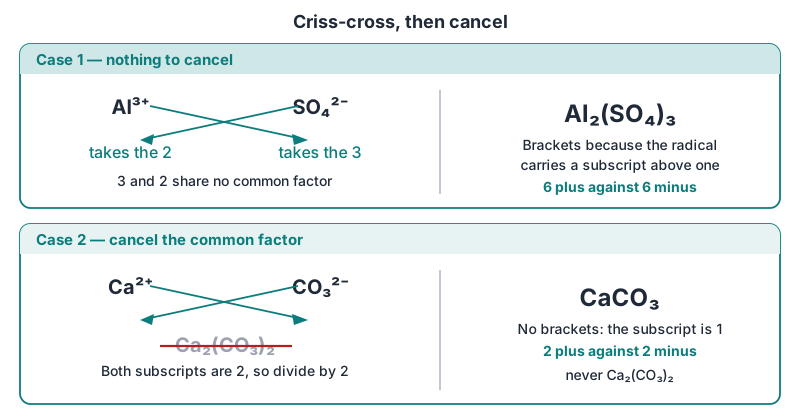
To write a formula, use the criss-cross rule: exchange the valencies as subscripts and cancel any common factor. Al³⁺ with SO₄²⁻ gives Al₂(SO₄)₃; Ca²⁺ with CO₃²⁻ gives CaCO₃, not Ca₂(CO₃)₂. A polyatomic radical takes brackets whenever its subscript is more than one.
Figure 1 Criss-cross, then cancel
Relative atomic mass and molecular mass; atomic mass unit
Atoms are too light to weigh one at a time, so chemistry works with relative masses. The relative atomic mass of an element is the mass of one of its atoms divided by one twelfth of the mass of one ¹²C atom. It is a ratio, so it has no unit.
One atomic mass unit (amu; written u or dalton in modern texts) is one twelfth of the mass of a ¹²C atom: 1 u = 1.66054 × 10⁻²⁴ g = 1.66054 × 10⁻²⁷ kg. Before 1961 chemists referred masses to natural oxygen as 16 and physicists to ¹⁶O as 16, which differed slightly; the ¹²C scale, agreed in 1961, replaced both.
Because most elements are mixtures of isotopes, the tabulated value is a weighted average. Chlorine is about 75 % ³⁵Cl and 25 % ³⁷Cl:
average = (35 × 75 + 37 × 25) ÷ 100 = (2625 + 925) ÷ 100 = 35.5
Check it back: a 35.5 average sits three quarters of the way from 37 down to 35, which is exactly a 75 : 25 mixture. That is why chlorine's atomic mass is fractional while no chlorine atom weighs 35.5 u.
Relative molecular mass is the sum of the atomic masses in the molecular formula: H₂SO₄ = (2 × 1) + 32 + (4 × 16) = 98. Ionic solids have no molecules, so NaCl has a formula mass of 58.5, not a molecular mass. Gram atomic mass and gram molecular mass are the same numbers expressed in grams, and each is one mole.
Vapour density compares a gas with hydrogen under the same conditions: VD = mass of a volume of the gas ÷ mass of the same volume of H₂. Since hydrogen's molecular mass is 2, molecular mass = 2 × VD. A gas of vapour density 22 has molecular mass 44 — CO₂ or N₂O.
Radicals
A radical is an atom or a group of atoms that carries a charge and passes through a reaction unchanged. Basic radicals are the cations, acid radicals the anions; the number after the sign is the valency. Learn these two tables; the paper never explains them.
| Valency | Basic radicals (cations) |
|---|---|
| 1 | H⁺, Na⁺, K⁺, Ag⁺, NH₄⁺ (ammonium), Cu⁺ (cuprous), Hg₂²⁺ counts as mercurous |
| 2 | Mg²⁺, Ca²⁺, Ba²⁺, Zn²⁺, Fe²⁺ (ferrous), Cu²⁺ (cupric), Pb²⁺, Sn²⁺, Mn²⁺, Hg²⁺ |
| 3 | Al³⁺, Fe³⁺ (ferric), Cr³⁺, Bi³⁺ |
| Valency | Acid radicals (anions) |
|---|---|
| 1 | Cl⁻, Br⁻, I⁻, OH⁻ (hydroxide), NO₃⁻ (nitrate), NO₂⁻ (nitrite), HCO₃⁻ (hydrogencarbonate), HSO₄⁻, ClO⁻ (hypochlorite), ClO₃⁻ (chlorate), MnO₄⁻ (permanganate), CN⁻ (cyanide), CH₃COO⁻ (acetate) |
| 2 | O²⁻, S²⁻ (sulphide), SO₄²⁻ (sulphate), SO₃²⁻ (sulphite), CO₃²⁻ (carbonate), S₂O₃²⁻ (thiosulphate), Cr₂O₇²⁻ (dichromate), CrO₄²⁻ (chromate), C₂O₄²⁻ (oxalate) |
| 3 | PO₄³⁻ (phosphate), N³⁻ (nitride), [Fe(CN)₆]³⁻ (ferricyanide) |
| 4 | [Fe(CN)₆]⁴⁻ (ferrocyanide) |
A compound is electrically neutral, so the total positive charge equals the total negative charge — that single rule generates every formula in the subject and is the fastest check on one you have written.
Molecular formula, empirical formula and chemical equations
The empirical formula gives the simplest whole-number ratio of atoms. The molecular formula gives the actual number in one molecule. They are linked by one integer:
molecular formula = (empirical formula) × n, where n = molecular mass ÷ empirical formula mass
| Compound | Empirical | Molecular | n |
|---|---|---|---|
| Ethyne | CH | C₂H₂ | 2 |
| Benzene | CH | C₆H₆ | 6 |
| Acetic acid | CH₂O | C₂H₄O₂ | 2 |
| Glucose | CH₂O | C₆H₁₂O₆ | 6 |
| Hydrogen peroxide | HO | H₂O₂ | 2 |
| Water | H₂O | H₂O | 1 |
Notice that benzene and ethyne share an empirical formula, and so do glucose and acetic acid. An empirical formula alone can never give a molecular formula — you always need a molecular mass or a vapour density as well. That sentence is itself an exam answer.
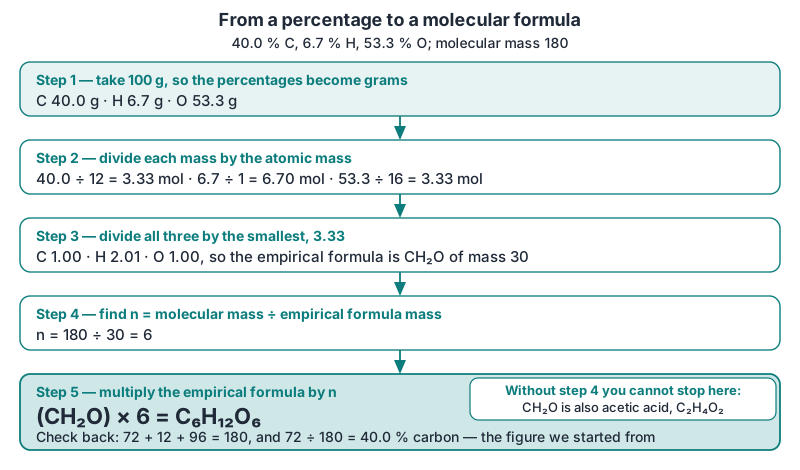
Worked example. A compound is 40.0 % carbon, 6.7 % hydrogen and 53.3 % oxygen, and its molecular mass is 180. Find both formulae.
Take 100 g, so the percentages become grams. Divide each mass by the atomic mass: carbon 40.0 ÷ 12 = 3.33 mol, hydrogen 6.7 ÷ 1 = 6.70 mol, oxygen 53.3 ÷ 16 = 3.33 mol. Divide all three by the smallest, 3.33: carbon 1.00, hydrogen 2.01, oxygen 1.00. The empirical formula is CH₂O, of mass 12 + 2 + 16 = 30. Then n = 180 ÷ 30 = 6, so the molecular formula is C₆H₁₂O₆.
Check the answer back into the question: C₆H₁₂O₆ has mass (6 × 12) + (12 × 1) + (6 × 16) = 72 + 12 + 96 = 180, which matches. Its carbon percentage is 72 ÷ 180 = 40.0 %, its hydrogen 12 ÷ 180 = 6.67 % and its oxygen 96 ÷ 180 = 53.3 % — the data we started from.
Figure 2 From a percentage to a molecular formula
Chemical equations are balanced by hit and trial: balance the element that appears in fewest formulae first, leave hydrogen and oxygen to last, and clear fractions by doubling. C₃H₈ + 5O₂ → 3CO₂ + 4H₂O balances as 3 carbons, 8 hydrogens and 10 oxygens on each side. The harder ones still fall to counting: 2KMnO₄ + 16HCl → 2KCl + 2MnCl₂ + 8H₂O + 5Cl₂ has 2 K, 2 Mn, 8 O, 16 H and 16 Cl (2 + 4 + 10) on both sides. Where the skeleton refuses to balance by inspection, the reaction is a redox one and needs the methods in Redox reactions.
Percentage composition
percentage of an element = (number of its atoms × its atomic mass) ÷ molecular mass × 100
Worked example. Find the percentage composition of calcium carbonate, CaCO₃. Its molecular mass is 40 + 12 + (3 × 16) = 100. Calcium is 40 ÷ 100 × 100 = 40.0 %, carbon 12 ÷ 100 × 100 = 12.0 %, oxygen 48 ÷ 100 × 100 = 48.0 %.
Check back: the three percentages add to 40.0 + 12.0 + 48.0 = 100.0, and 40 % of the 100 g formula mass is the 40 g of calcium the formula demands. Adding to 100 is the check to run every time.
Worked example. Which fertiliser carries more nitrogen, urea CO(NH₂)₂ or ammonium sulphate (NH₄)₂SO₄? Urea's molecular mass is 12 + 16 + (2 × 14) + (4 × 1) = 60, of which nitrogen is 28, so 28 ÷ 60 × 100 = 46.7 %. Ammonium sulphate is (2 × 18) + 32 + (4 × 16) = 132, of which nitrogen is 28, so 28 ÷ 132 × 100 = 21.2 %.
Check back: 46.7 % of 60 is 28.0 g and 21.2 % of 132 is 28.0 g — both compounds do carry 28 mass units of nitrogen per formula, and urea wins because the rest of its molecule is lighter. Urea is the solid nitrogen fertiliser with the highest nitrogen percentage, which is exactly why it dominates the bags sold in Nepal.
Numbers and names to memorise
| Item | Value |
|---|---|
| 1 atomic mass unit | 1.66054 × 10⁻²⁴ g = 1.66054 × 10⁻²⁷ kg |
| Defined against | One twelfth of the mass of a ¹²C atom (scale agreed 1961) |
| Molecular mass from vapour density | Molecular mass = 2 × VD |
| Molecular from empirical | n = molecular mass ÷ empirical formula mass |
| Average atomic mass of chlorine | 35.5 (about 75 % ³⁵Cl, 25 % ³⁷Cl) |
| Molecular masses worth knowing | H₂O 18, CO₂ 44, NaCl 58.5, NaOH 40, CaCO₃ 100, H₂SO₄ 98, HNO₃ 63, NH₃ 17, glucose 180, urea 60 |
| Nitrogen in urea / in ammonium sulphate | 46.7 % / 21.2 % |
| Atomicity to quote | P₄ tetratomic, S₈ polyatomic, O₃ triatomic, noble gases monoatomic |
| Electronegative valency | 8 − group number |
Traps
- An empirical formula can never be turned into a molecular formula without a molecular mass or vapour density. Benzene and ethyne are both CH.
- A radical in inorganic chemistry carries a charge; a free radical in organic chemistry is neutral with an unpaired electron. Same word, different object — check which chapter the question comes from.
- NaCl has a formula mass, not a molecular mass. There is no NaCl molecule in the crystal.
- Relative atomic mass has no unit — it is a ratio. The gram atomic mass does.
- Chlorine's 35.5 is an average, not the mass of any chlorine atom.
- Criss-cross then cancel. Ca²⁺ with CO₃²⁻ is CaCO₃, never Ca₂(CO₃)₂.
- Vapour density is half the molecular mass, not twice it. Confusing the direction turns a 44 into an 11.
- Percentages must add to 100. If they do not, you have used the wrong molecular mass — recheck before going on.
- Divide by the smallest, then clear the fraction. A ratio of 1 : 1.5 is 2 : 3, not 1 : 2.
Quick check
0 of 5 answered- 1One atomic mass unit is defined as
- 2A compound has the empirical formula CH₂O and a vapour density of 30. Its molecular formula is
- 3Which formula is written correctly for aluminium sulphate?
- 4The percentage of nitrogen in ammonium nitrate, NH₄NO₃, is closest to
- 5Why is the relative atomic mass of chlorine 35.5 although every chlorine atom has a whole number of nucleons?
Sources
- MEC syllabus, third revision (28 April 2026), Chemistry unit 1 Physical chemistry, chapter 1 scope points — headings and order.
- Wikipedia (CC BY-SA), read 22 September 2026, paraphrased for the mass scale and its history: Dalton (unit), Relative atomic mass, Isotopes of chlorine, Empirical formula.
- NIST reference data for the atomic mass constant and the isotopic abundances of chlorine.
- NCERT Class 11 Chemistry, Some Basic Concepts of Chemistry — consulted for the depth and worked-example style Nepal candidates are taught.
- Nepal CDC Grade 11 Chemistry — consulted for the radical tables and the criss-cross convention.
- All arithmetic worked forward and checked back by the author.
- Figures: credited in each caption (original diagrams unless a caption says otherwise).