In the paper
Unit 1 carries 17 of the 50 chemistry marks; with fourteen chapters sharing them, this one averages a little over one (MEC publishes weights by unit, not by chapter). It punches above that because the mole is the entry ticket to Volumetric analysis, States of matter and every gas calculation in the paper. There is an older whole-topic note, Mole Concept and Stoichiometry Made Simple, worth a skim; this one is the chapter proper, written to MEC's scope points.
The MEC scope line runs: Dalton's atomic theory; laws of stoichiometry; Avogadro's law and its applications; mole concept; limiting reactants; percentage yield; related numerical problems. The headings below are its points, in MEC's order.
Three ways it comes: recall (which law Proust gave, what Avogadro's number is); understanding (why Gay-Lussac's volume law needed Avogadro's hypothesis to make sense); application (a limiting-reagent mass, a percentage yield, a volume of gas at STP). Expect the application questions here to be the numerical backbone of the whole chemistry section.
Dalton's atomic theory
John Dalton (1808) built chemistry's first quantitative atomic model on five postulates: matter is made of indivisible atoms; the atoms of one element are identical in mass and properties; atoms of different elements differ; atoms combine in small whole-number ratios; and atoms are neither created nor destroyed in a chemical change.
Those postulates explained the laws of combination at a stroke — and three of them are now known to be wrong.
| Postulate | What broke it |
|---|---|
| The atom is indivisible | Electrons, protons and neutrons; see Atomic structure |
| Atoms of an element are identical in mass | Isotopes — ³⁵Cl and ³⁷Cl |
| Atoms of different elements differ in mass | Isobars — ⁴⁰Ar, ⁴⁰K and ⁴⁰Ca all have mass number 40 |
| Atoms combine in small whole-number ratios | Non-stoichiometric compounds (Fe₀.₉₅O) and polymers |
| Atoms are conserved | True in chemistry; broken by Nuclear chemistry |
The exam does not want the theory defended; it wants the postulate matched to the exception.
Laws of stoichiometry
| Law | Statement | Worked illustration |
|---|---|---|
| Conservation of mass (Lavoisier, 1789) | Mass is neither created nor destroyed in a chemical change | 25 g CaCO₃ gives 14 g CaO and 11 g CO₂ |
| Constant (definite) proportions (Proust, 1799) | A pure compound always holds the same elements in the same mass ratio, whatever its source | Water from any source is 2 g H to 16 g O, that is 1 : 8 |
| Multiple proportions (Dalton, 1803) | When two elements form more than one compound, the masses of one combining with a fixed mass of the other are in a simple whole-number ratio | With 12 g of carbon, CO takes 16 g of oxygen and CO₂ takes 32 g — a ratio of 1 : 2 |
| Reciprocal proportions (Richter, 1792) | The masses of two elements that combine with a fixed mass of a third are in the same ratio, or a simple multiple of it, as when they combine with each other | Worked below |
| Gay-Lussac's law of gaseous volumes (1808) | Gases react, and form gaseous products, in volume ratios that are simple whole numbers at the same temperature and pressure | H₂ + Cl₂ → 2HCl is 1 : 1 : 2 by volume |
Reciprocal proportions, worked. In H₂O, 2 g of hydrogen holds 16 g of oxygen, so 1 g of hydrogen goes with 8 g of oxygen. In H₂S, 2 g of hydrogen holds 32 g of sulphur, so 1 g of hydrogen goes with 16 g of sulphur. The ratio sulphur : oxygen is therefore 16 : 8 = 2 : 1. Now look at how they combine directly, in SO₂: 32 g of sulphur with 32 g of oxygen, a ratio of 1 : 1. Dividing, 2 : 1 divided by 1 : 1 is 2, a simple whole number — which is what the law claims.
Check it back the other way: if the law holds, SO₃ should give a different but equally simple number. In SO₃, 32 g of sulphur takes 48 g of oxygen, a ratio of 2 : 3; dividing 2 : 1 by 2 : 3 gives 3, again a whole number.
Note the split: the first four laws are mass laws; Gay-Lussac's is a volume law and applies only to gases.
Avogadro's law and its applications
Avogadro's hypothesis (1811): equal volumes of all gases, at the same temperature and pressure, contain equal numbers of molecules. It was the missing piece under Gay-Lussac's whole-number volumes — Dalton had rejected the idea that an element could exist as a diatomic molecule, so his atoms would not divide when hydrogen and chlorine gave twice their volume of HCl.
Its applications are a standard four-mark list:
- Molecular formulae of gases from volume data. One volume of hydrogen and one of chlorine give two of HCl. Two molecules of HCl need two hydrogen atoms and two chlorine atoms from one molecule of each, so both must be diatomic.
- Atomicity of the elementary gases. The same argument fixes H₂, O₂, N₂ and Cl₂ as diatomic and the noble gases as monoatomic.
- Molecular mass = 2 × vapour density. Equal volumes hold equal numbers, so the mass ratio of a gas to hydrogen is the ratio of their molecular masses; hydrogen's is 2.
- The molar volume. One mole of any gas occupies the same volume under given conditions — 22.4 L at STP.
- The relation between mass and volume, which is what makes the gas half of every stoichiometry problem possible.
A convention to be careful about. The Grade 11–12 textbooks define STP as 0 °C and 1 atm, giving a molar volume of 22.4 L mol⁻¹, and that is the number to use in this paper. IUPAC has since defined standard pressure as 1 bar, which at 0 °C gives 22.7 L mol⁻¹, and SATP (25 °C, 1 bar) gives 24.8 L mol⁻¹. If an option list offers 22.4 and 22.7, the Grade 11–12 convention wants 22.4.
Mole concept
A mole is the amount of substance containing as many elementary entities as there are atoms in 12 g of carbon-12 — the definition the Grade 11–12 texts use. That number, Avogadro's number, N_A = 6.022 × 10²³ mol⁻¹, was fixed exactly at 6.02214076 × 10²³ in the 2019 SI revision, which now defines the mole by that number rather than by carbon-12. Either statement earns the mark; the numerical value is unchanged to four figures.
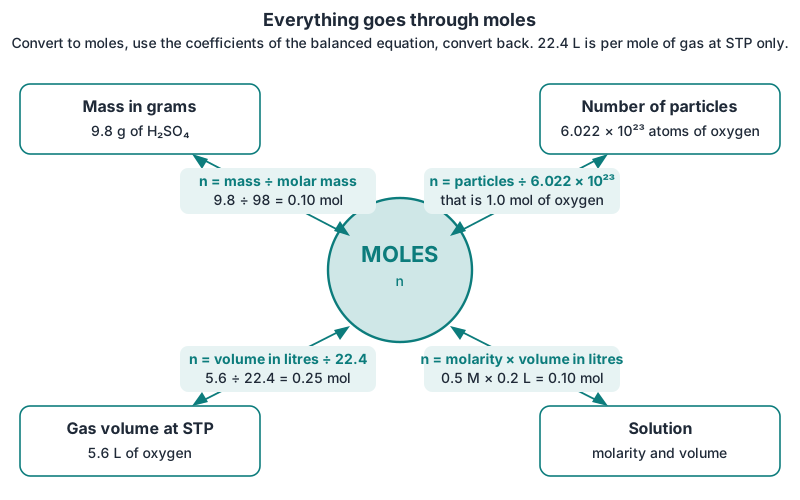
One mole is, at the same time, four things:
| Route | Relation |
|---|---|
| Mass | n = mass in grams ÷ molar mass in g mol⁻¹ |
| Number | n = number of particles ÷ 6.022 × 10²³ |
| Gas volume at STP | n = volume in litres ÷ 22.4 |
| Solution | n = molarity × volume in litres |
Everything in this chapter is one of those four conversions followed by a mole ratio read off the balanced equation. Always convert to moles first, use the coefficients, then convert back.
Figure 1 The mole as a conversion hub
Limiting reactants
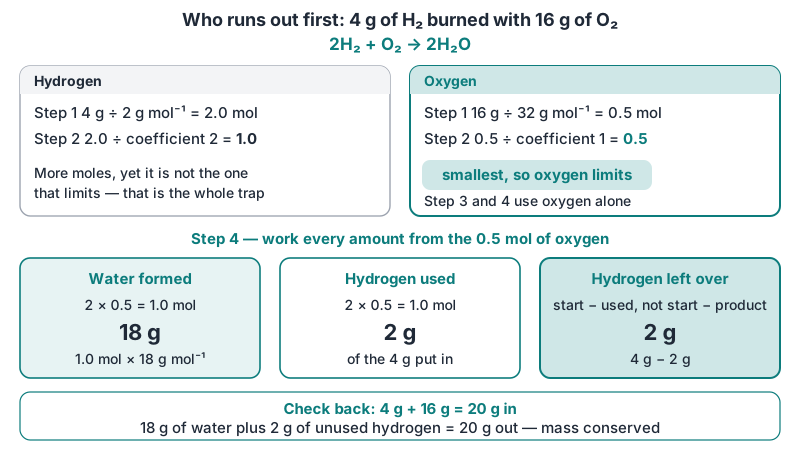
The limiting reactant is the one that runs out first; it fixes how much product can form, and the rest of the other reactant is left over. Do not guess from the masses — the method is mechanical:
- Convert every reactant mass to moles.
- Divide each number of moles by that reactant's coefficient in the balanced equation.
- The smallest quotient is the limiting reactant.
- Work all product amounts from the limiting reactant alone.
Skipping step 2 is the commonest error in the chapter: the reactant present in fewer moles is not always the one that limits.
Figure 2 Limiting reagent, worked
Percentage yield
Reactions lose material to side reactions, reversibility and transfer losses, so the mass actually collected is below the calculated one.
percentage yield = (actual yield ÷ theoretical yield) × 100
The theoretical yield is what the limiting-reactant calculation predicts. Two cautions: percentage yield is never above 100 % (a value above it means the product is wet or impure), and a percentage purity question runs the same arithmetic on the reactant side, not the product side.
Related numerical problems
Ten graded problems, each solved forward and then checked by putting the answer back into the question.
1. Mass to moles. How many moles are in 9.8 g of H₂SO₄? Its molar mass is (2 × 1) + 32 + (4 × 16) = 98 g mol⁻¹. n = 9.8 g ÷ 98 g mol⁻¹ = 0.10 mol. Check: 0.10 mol × 98 g mol⁻¹ = 9.8 g.
2. Moles to particles. How many oxygen atoms are in 0.25 mol of H₂SO₄? Each formula unit holds 4 oxygen atoms, so the amount of oxygen is 0.25 × 4 = 1.0 mol, which is 1.0 × 6.022 × 10²³ = 6.022 × 10²³ atoms. Check: 6.022 × 10²³ atoms ÷ 6.022 × 10²³ mol⁻¹ = 1.0 mol of oxygen, and 1.0 ÷ 4 = 0.25 mol of acid.
3. Mass to gas volume. What volume does 8 g of oxygen occupy at STP? n = 8 g ÷ 32 g mol⁻¹ = 0.25 mol; V = 0.25 mol × 22.4 L mol⁻¹ = 5.6 L. Check: 5.6 L ÷ 22.4 L mol⁻¹ = 0.25 mol, and 0.25 mol × 32 g mol⁻¹ = 8 g.
4. Vapour density to molar mass. A gas has vapour density 22. Its molar mass is 2 × 22 = 44 g mol⁻¹, so it could be CO₂ or N₂O. Check: CO₂ is 12 + 32 = 44, and 44 ÷ 2 = 22.
5. Percentage to molecular formula. A hydrocarbon is 85.7 % carbon and 14.3 % hydrogen with a vapour density of 21. In 100 g there are 85.7 ÷ 12 = 7.14 mol of carbon and 14.3 ÷ 1 = 14.3 mol of hydrogen. Dividing by 7.14 gives 1 : 2, so the empirical formula is CH₂, of mass 14. The molar mass is 2 × 21 = 42, so n = 42 ÷ 14 = 3 and the molecular formula is C₃H₆. Check: C₃H₆ has mass 36 + 6 = 42, giving 36 ÷ 42 = 85.7 % carbon and 6 ÷ 42 = 14.3 % hydrogen.
6. Mass to mass. What mass of quicklime comes from fully decomposing 25 g of limestone? CaCO₃ → CaO + CO₂. n(CaCO₃) = 25 g ÷ 100 g mol⁻¹ = 0.25 mol, and the ratio is 1 : 1, so n(CaO) = 0.25 mol and its mass is 0.25 × 56 = 14 g. Check: the CO₂ released is 0.25 × 44 = 11 g, and 14 + 11 = 25 g — mass conserved, as Lavoisier's law demands.
7. Mass to volume. What volume of CO₂ at STP does that same 25 g of limestone give? n(CO₂) = 0.25 mol, so V = 0.25 × 22.4 = 5.6 L. Check: 5.6 L is 0.25 mol, which weighs 11 g — the same 11 g that balanced problem 6.
8. Limiting reactant. 4 g of hydrogen is burned with 16 g of oxygen. What mass of water forms, and what is left over? The equation is 2H₂ + O₂ → 2H₂O. Moles: hydrogen 4 ÷ 2 = 2.0 mol, oxygen 16 ÷ 32 = 0.5 mol. Divide by the coefficients: hydrogen 2.0 ÷ 2 = 1.0, oxygen 0.5 ÷ 1 = 0.5. Oxygen limits. Water = 2 × 0.5 = 1.0 mol = 18 g. The hydrogen used is also 1.0 mol = 2 g, so 2 g of hydrogen is left. Check: 4 + 16 = 20 g in, and 18 g of water plus 2 g of unused hydrogen = 20 g out.
9. Percentage yield, forward. 28 g of nitrogen with excess hydrogen gives 27.2 g of ammonia. What is the yield? N₂ + 3H₂ → 2NH₃, and n(N₂) = 28 ÷ 28 = 1.0 mol, so the theoretical ammonia is 2.0 mol = 34 g. Yield = 27.2 ÷ 34 × 100 = 80 %. Check: 80 % of 34 g is 27.2 g.
10. Percentage yield, backward. What mass of limestone must be decomposed to collect 5.6 g of quicklime if the process runs at 80 % yield? The 5.6 g is 5.6 ÷ 56 = 0.10 mol of CaO actually collected, so the theoretical amount is 0.10 ÷ 0.80 = 0.125 mol, needing 0.125 mol of CaCO₃ = 12.5 g. Check: 12.5 g of CaCO₃ is 0.125 mol, whose theoretical CaO is 0.125 × 56 = 7.0 g, and 80 % of 7.0 g is 5.6 g.
Numbers and names to memorise
| Item | Value |
|---|---|
| Avogadro's number | 6.022 × 10²³ mol⁻¹ (exactly 6.02214076 × 10²³ since 2019) |
| Molar volume at STP (0 °C, 1 atm) | 22.4 L mol⁻¹ — the Grade 11–12 convention |
| Molar volume at 0 °C and 1 bar / at SATP | 22.7 L mol⁻¹ / 24.8 L mol⁻¹ |
| Molecular mass from vapour density | 2 × VD |
| Conservation of mass / definite proportions | Lavoisier 1789 / Proust 1799 |
| Multiple proportions / reciprocal proportions | Dalton 1803 / Richter 1792 |
| Gaseous volumes / equal volumes equal molecules | Gay-Lussac 1808 / Avogadro 1811 |
| Dalton's atomic theory | 1808; broken by isotopes, isobars and subatomic particles |
| Percentage yield | actual ÷ theoretical × 100, never above 100 % |
| Molar masses to have ready | H₂O 18, CO₂ 44, O₂ 32, N₂ 28, NH₃ 17, CaO 56, CaCO₃ 100, H₂SO₄ 98, NaOH 40, NaCl 58.5 |
Traps
- Divide the moles by the coefficient before comparing. The reactant present in fewer moles is not automatically the limiting one.
- 22.4 L is per mole of gas at STP only. It says nothing about liquids or solids, and nothing at room temperature.
- Gay-Lussac's law is about volumes of gases; the other four laws of combination are about masses.
- Isotopes break Dalton's second postulate, isobars his third. Do not swap them.
- Vapour density is half the molecular mass. A VD of 21 is a molar mass of 42.
- Percentage yield cannot exceed 100 % — if a calculation says it does, the arithmetic or the balanced equation is wrong.
- Avogadro's number counts entities, not atoms. One mole of H₂SO₄ holds 6.022 × 10²³ formula units but 4 × 6.022 × 10²³ oxygen atoms.
- Balance the equation before using any ratio. An unbalanced equation gives a confidently wrong answer.
- Excess reactant left over is a mass question in its own right; compute it as (start − used), not as (start − product).
Quick check
0 of 5 answered- 1Which law is broken by the existence of isotopes?
- 2At STP, 11.2 L of a gas weighs 22 g. Its molar mass is
- 3Carbon forms CO and CO₂. With a fixed 12 g of carbon, the masses of oxygen are 16 g and 32 g. This illustrates the law of
- 42 mol of Al reacts with 2 mol of Cl₂ by 2Al + 3Cl₂ → 2AlCl₃. The limiting reactant is
- 5Equal volumes of gases at the same temperature and pressure contain equal numbers of molecules. This statement is
Sources
- MEC syllabus, third revision (28 April 2026), Chemistry unit 1 Physical chemistry, chapter 2 scope points — headings and order.
- Wikipedia (CC BY-SA), read 22 September 2026, paraphrased for dates and statements: John Dalton, Law of multiple proportions, Law of reciprocal proportions, Gay-Lussac's law, Avogadro's law, Mole (unit), Molar volume.
- BIPM SI Brochure (9th edition) for the 2019 redefinition of the mole and the fixed value of the Avogadro constant.
- NCERT Class 11 Chemistry, Some Basic Concepts of Chemistry — consulted for the numerical style and the STP convention taught in Nepal.
- Every numerical above worked forward and checked back by the author.
- Figures: credited in each caption (original diagrams unless a caption says otherwise).