In the paper
Unit 1 carries 10 of the 50 physics marks; with eight chapters sharing them, this one averages a little over one (MEC publishes weights by unit, not by chapter). Kinematics earns more than its share, though, because it is reused: every dynamics numerical ends in an equation of motion, circular motion and simple harmonic motion borrow its graphs, and the projectile formulae come back in electric and magnetic fields, where a charged particle between plates traces exactly the same parabola.
The MEC scope line runs: Concepts, calculations and graphical treatment of linear and projectile motion, with and without resistive force. That single line is the section below; its parts are the subheadings.
Three ways it comes:
- Recall — the formula for the range of a projectile, the ratio of distances covered in successive seconds of free fall, the unit of the displacement in the nth second.
- Understanding — why the area under a velocity–time graph is the displacement, why a displacement–time graph can never be vertical, why the acceleration at the top of a projectile's flight is not zero, why the time of flight of a horizontally projected body does not depend on how fast it was thrown.
- Application — a stone thrown up from a tower, the range and height of a projectile at a given angle, the overtaking time of two trains, a two-stage journey read off a velocity–time graph.
Concepts, calculations and graphical treatment of linear and projectile motion, with and without resistive force
The words, used exactly
| Pair | The difference |
|---|---|
| Distance / displacement | Distance is the path length, a scalar, never decreasing. Displacement is the straight line from start to finish, a vector, which can be zero or negative |
| Speed / velocity | Speed is a scalar; velocity is a vector. Speed can be constant while velocity changes (uniform circular motion) |
| Average / instantaneous | Average velocity = total displacement ÷ total time. Instantaneous velocity is the slope of the tangent to the displacement–time curve |
| Acceleration / retardation | Acceleration is the rate of change of velocity. It is called retardation when it opposes the velocity — but its sign depends on the axis you chose, not on whether the body is slowing |
Two consequences the paper likes. First, average speed ≥ |average velocity| always, with equality only for motion in a straight line without reversing. Second, a runner who completes one lap of a circular track has covered a distance 2πr, a displacement of zero, and therefore an average velocity of zero while their average speed is not.
Average speed over two legs. For equal distances at v₁ and v₂ the average is the harmonic mean 2v₁v₂/(v₁ + v₂); for equal times it is the arithmetic mean (v₁ + v₂)/2.
Worked. A car covers the first half of a journey at 40 km h⁻¹ and the second half at 60 km h⁻¹. Average speed = 2(40)(60)/(40 + 60) = 4800/100 = 48 km h⁻¹. Checked back with 120 km each way: 3 h + 2 h = 5 h for 240 km, which is 48 km h⁻¹. It is not 50 — the car spends longer in the slow half.
The equations of motion
For motion in a straight line with constant acceleration a, starting at velocity u and reaching v after time t across a displacement s:
v = u + at
s = ut + ½at²
v² = u² + 2as
s = (u + v)t / 2
s_nth = u + (a/2)(2n − 1)
where u and v are in m s⁻¹, a in m s⁻², t in s and s in m. The last line is the displacement during the nth second — its unit is the metre, not m s⁻¹, however much the name suggests otherwise, because it is a displacement over an interval of exactly one second.
Every one of these fails the moment the acceleration changes. For non-uniform acceleration only v = dx/dt and a = dv/dt survive, and in this syllabus that means reading a graph.
Worked. A body starts from rest with a = 2 m s⁻². The distance covered in the 5th second is s₅ = 0 + (2/2)(2 × 5 − 1) = 9 m. Checked back: s after 5 s = ½(2)(25) = 25 m, s after 4 s = ½(2)(16) = 16 m, and 25 − 16 = 9 m.
Graphical treatment
This is where marks are lost, so learn it as a table rather than as prose.
| Graph | What the slope gives | What the area gives | What the intercept gives |
|---|---|---|---|
| Displacement–time | Velocity | Nothing physical | Initial position |
| Velocity–time | Acceleration | Displacement (take the modulus of each piece for distance) | Initial velocity u |
| Acceleration–time | Rate of change of acceleration (not asked) | Change in velocity | Initial acceleration |
And the shapes:
| Motion | Displacement–time | Velocity–time | Acceleration–time |
|---|---|---|---|
| At rest | Horizontal line | Lies on the time axis | On the axis |
| Uniform velocity | Straight line, constant slope | Horizontal line above the axis | On the axis |
| Uniform acceleration from rest | Parabola through the origin, steepening | Straight line through the origin, slope a | Horizontal line above the axis |
| Uniform retardation | Parabola that flattens | Straight line sloping down to the axis | Horizontal line below the axis |
| Body thrown up and falling back | Inverted parabola | Straight line crossing the axis at the top of the flight | Horizontal line at −g throughout |
Four rules that answer most graph questions:
- A displacement–time graph can never be vertical: that would mean infinite velocity.
- A negative slope on a displacement–time graph means motion back towards the origin.
- Area under the velocity–time graph below the axis is negative displacement. For the distance, add the areas as positive numbers; for the displacement, keep the signs.
- A curved velocity–time graph means the acceleration itself is changing, so none of the three equations applies.
Deriving the equations from the graph — result first. On a velocity–time graph of uniform acceleration, the line runs from u at t = 0 to v at time t. The slope is (v − u)/t = a, which rearranges to v = u + at. The area under it is a rectangle u·t plus a triangle ½·t·(v − u) = ½at², giving s = ut + ½at². Treating the area instead as a trapezium of parallel sides u and v gives s = (u + v)t/2, and eliminating t between that and the first result gives v² = u² + 2as. Three lines, and they are the three lines an examiner wants to see.
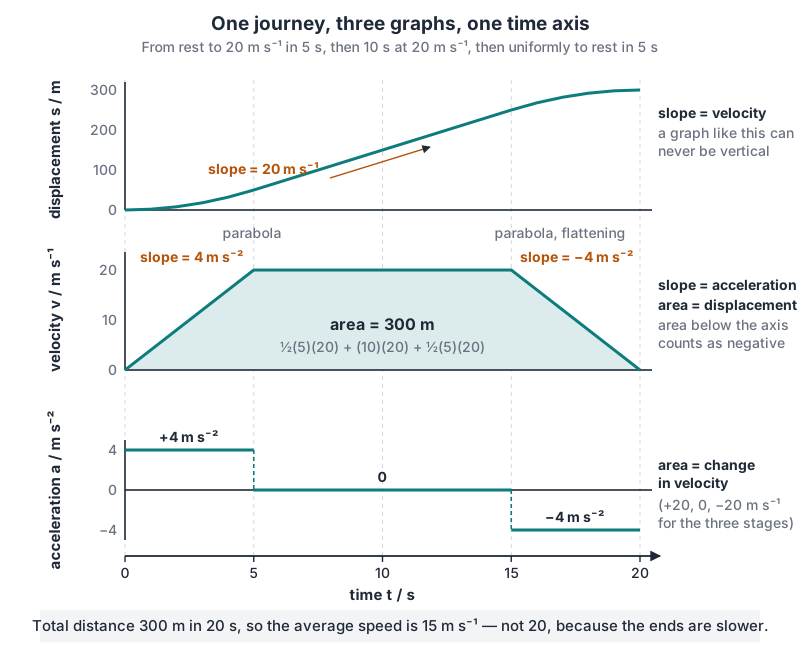
Worked graph reading. A body accelerates uniformly from rest to 20 m s⁻¹ in 5 s, holds that speed for 10 s, then decelerates uniformly to rest in 5 s. Distance = ½(5)(20) + (10)(20) + ½(5)(20) = 50 + 200 + 50 = 300 m in 20 s, so the average speed is 15 m s⁻¹. Checked back: the whole area is a trapezium of parallel sides 20 s and 10 s and height 20 m s⁻¹, which is ½(20 + 10)(20) = 300 m.
Figure 1 One journey, three graphs
Free fall
Take g = 9.8 m s⁻² downward (many questions use 10 m s⁻² so that the options come out round; the note says which is in use each time). Take upward as positive, so the acceleration is −g throughout, including at the highest point.
For a body thrown up with speed u:
- Time to the top: t = u/g
- Maximum height: H = u²/2g
- Total time of flight back to the launch level: T = 2u/g
- It returns to the launch level with the same speed u, downward
- At any height the upward and downward speeds are equal
For a body dropped from rest: v = gt, h = ½gt², v = √(2gh). The distances fallen in the first, second, third … second are in the ratio 1 : 3 : 5 : 7, which is Galileo's odd-number rule and a favourite recall question.
Worked 1. A stone is thrown vertically up at 19.6 m s⁻¹ (g = 9.8). Time to the top = 19.6/9.8 = 2.0 s; H = (19.6)²/(2 × 9.8) = 384.16/19.6 = 19.6 m; total flight = 4.0 s. Checked back: at t = 2 s, h = 19.6(2) − ½(9.8)(4) = 39.2 − 19.6 = 19.6 m.
Worked 2. A ball is dropped from 78.4 m (g = 9.8). t = √(2 × 78.4/9.8) = √16 = 4.0 s, striking at v = 9.8 × 4 = 39.2 m s⁻¹. Checked back: ½(9.8)(16) = 78.4 m.
Worked 3 — the tower question. A ball is thrown vertically up at 20 m s⁻¹ from the top of a 25 m tower (g = 10). Taking up as positive and the ground as −25 m:
−25 = 20t − 5t², so 5t² − 20t − 25 = 0, t² − 4t − 5 = 0, (t − 5)(t + 1) = 0, giving t = 5.0 s.
It lands at v = 20 − 10(5) = −30, that is 30 m s⁻¹ downward, and it rose 20²/20 = 20 m above the tower, so 45 m above the ground. Checked back with v² = u² + 2as: v² = 400 + 2(−10)(−25) = 400 + 500 = 900, so v = 30 m s⁻¹.
Relative motion in a line
v_AB = v_A − v_B. Along the same line this is a subtraction of signed numbers: same direction gives the difference, opposite directions the sum.
Worked. A 100 m train travelling at 20 m s⁻¹ overtakes a 100 m train travelling at 10 m s⁻¹ in the same direction. The relative speed is 10 m s⁻¹ and the relative displacement needed is 100 + 100 = 200 m, so the overtaking takes 200/10 = 20 s. Checked back: in 20 s the fast train covers 400 m and the slow one 200 m, a gain of exactly 200 m.
Worked. Two cars approach each other at 15 m s⁻¹ and 25 m s⁻¹ from 800 m apart. They close at 40 m s⁻¹, so they meet after 800/40 = 20 s. Checked back: 300 m + 500 m = 800 m.
Projectile motion
A projectile is a body given an initial velocity and then left to gravity alone. The whole subject rests on one idea: the horizontal and vertical motions are independent. Horizontally there is no acceleration, so the horizontal velocity is constant; vertically the body is in free fall. The resulting path is a parabola.
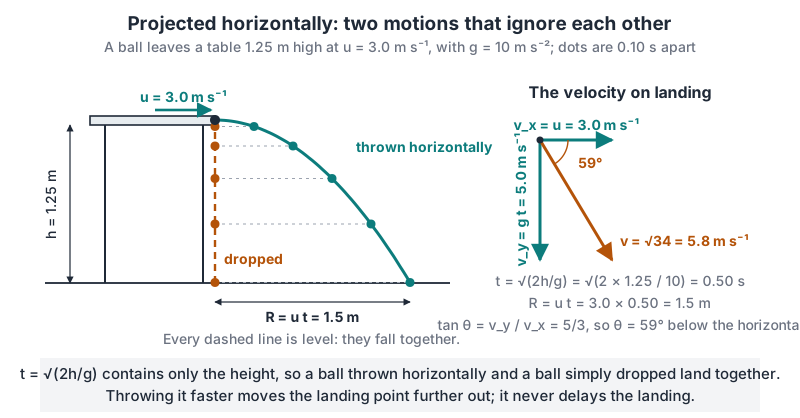
(a) Projected horizontally with speed u from height h.
- Time of flight: t = √(2h/g) — it depends only on h, so a bullet fired horizontally and a bullet dropped from the same height hit the ground together.
- Horizontal range: R = u√(2h/g)
- Velocity after time t: v = √(u² + g²t²), directed at tan θ = gt/u below the horizontal
- Trajectory: y = (g/2u²)x², a parabola
Worked. A ball rolls off a table 1.25 m high at 3.0 m s⁻¹ (g = 10). t = √(2 × 1.25/10) = √0.25 = 0.50 s; it lands 1.5 m from the table foot with a vertical speed of 10 × 0.5 = 5.0 m s⁻¹, so the landing speed is √(3² + 5²) = √34 = 5.8 m s⁻¹. Checked back: ½(10)(0.5)² = 1.25 m, the table height.
Figure 2 Horizontal projection: two motions that ignore each other
(b) Projected at angle θ to the horizontal with speed u.
Resolve once: u_x = u cos θ (constant), u_y = u sin θ.
| Quantity | Result |
|---|---|
| Time to the highest point | t = u sin θ / g |
| Time of flight | T = 2u sin θ / g |
| Maximum height | H = u² sin²θ / 2g |
| Horizontal range | R = u² sin 2θ / g |
| Maximum range | R_max = u²/g, at θ = 45° |
| Velocity at the top | u cos θ, horizontal — the minimum speed of the flight |
| Speed on landing | u again, at θ below the horizontal |
| Trajectory | y = x tan θ − gx²/(2u² cos²θ) |
| Relation of R and H | tan θ = 4H/R, so R = 4H when θ = 45° |
Three results that get asked as understanding questions:
- Complementary angles give the same range. Since sin 2θ = sin(180° − 2θ), a launch at 30° and one at 60° land in the same place — but the 60° shot goes higher and stays up longer. Their heights are in the ratio tan²θ.
- At the highest point the velocity is horizontal but the acceleration is still g downward. An option saying the acceleration is zero there is the commonest wrong answer in the chapter.
- The maximum height of a vertical throw is R_max/2: u²/2g against u²/g.
Worked. A ball is thrown at 20 m s⁻¹ at 30° to the horizontal (g = 10). u_y = 10 m s⁻¹, u_x = 17.3 m s⁻¹. T = 2(10)/10 = 2.0 s; H = (10)²/(2 × 10) = 5.0 m; R = (400)(sin 60°)/10 = 400 × 0.866/10 = 34.6 m. Checked back: R = u_x × T = 17.3 × 2.0 = 34.6 m, and H = u_y²/2g = 100/20 = 5.0 m.
Figure 3 Range, height and the complementary pair
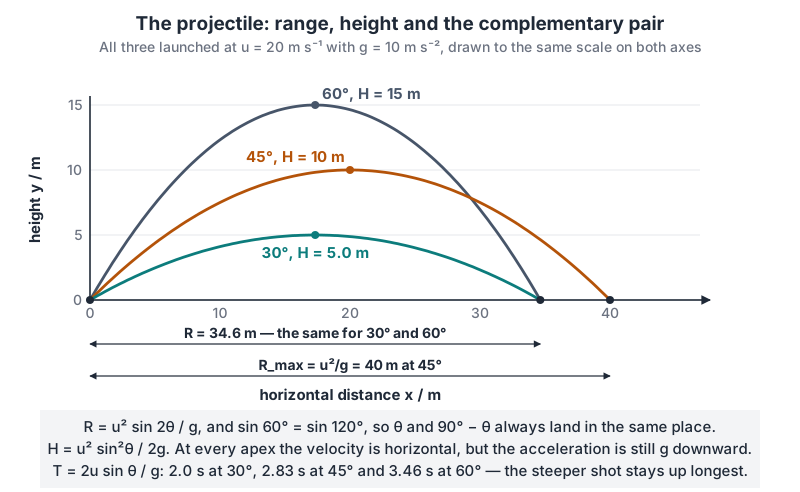
Worked. A ball leaves at 30 m s⁻¹ (g = 10). Its greatest possible range is u²/g = 900/10 = 90 m, at 45°. At 30° the range is 900 × sin 60°/10 = 77.9 m, and at 60° it is the same 77.9 m. Checked back: sin 60° = sin 120° = 0.866.
With a resistive force
Air resistance is a drag force opposite to the velocity, growing with speed — roughly proportional to v for small slow bodies and to v² for larger, faster ones. The syllabus wants the effects described, not calculated.
On a projectile, drag changes every result above:
| Feature | Without air resistance | With air resistance |
|---|---|---|
| Path | Symmetrical parabola | Not a parabola; the descending half is steeper and shorter |
| Range and maximum height | R = u² sin2θ/g, H = u² sin²θ/2g | Both smaller |
| Time up against time down | Equal | Time of descent is longer than the ascent |
| Speed on landing | Equal to the launch speed u | Less than u |
| Best angle for range | 45° | Less than 45° |
On a body falling from rest, drag rises as the body speeds up, so the net downward force and therefore the acceleration fall. When the drag equals the weight the acceleration becomes zero and the speed stops rising: the body has reached its terminal velocity.
Figure 4 Terminal velocity in two graphs
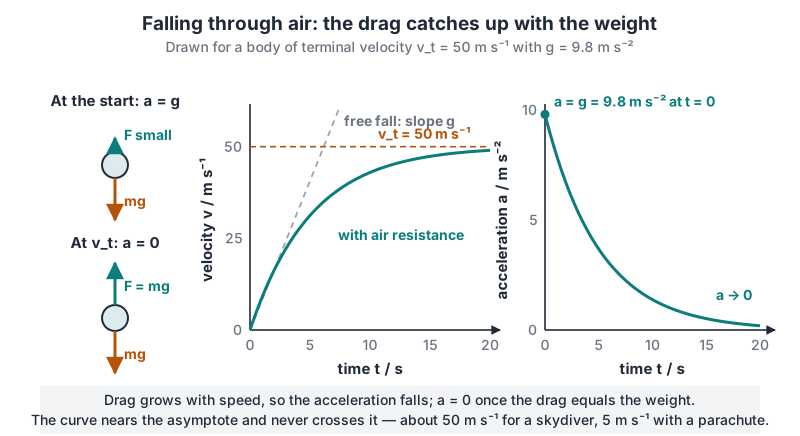
- Velocity–time graph: starts with slope g at the origin, curves over, and flattens to a horizontal asymptote at v_t. It approaches the asymptote but never crosses it.
- Acceleration–time graph: starts at g and falls smoothly to zero.
- For a small sphere in a viscous fluid, Stokes's law gives v_t = 2r²(ρ − σ)g/9η — derived in Fluid statics and dynamics.
- Everyday values: a large raindrop settles near 9 m s⁻¹; a skydiver reaches roughly 50 m s⁻¹ spread-eagled and about 5 m s⁻¹ once the parachute opens — the parachute works by multiplying the area, not by adding a force.
The famous consequence is that a feather and a coin fall together only in a vacuum. In air the feather's drag matches its tiny weight almost at once.
Numbers and names to memorise
| Item | Value or statement |
|---|---|
| Equations of motion | v = u + at; s = ut + ½at²; v² = u² + 2as |
| Displacement in the nth second | s = u + (a/2)(2n − 1), in metres |
| Slope of a velocity–time graph | Acceleration |
| Area under a velocity–time graph | Displacement |
| Area under an acceleration–time graph | Change in velocity |
| Free-fall distances in successive seconds | 1 : 3 : 5 : 7 |
| Maximum height of a vertical throw | H = u²/2g |
| Time of flight of a vertical throw | T = 2u/g |
| Horizontal projection from height h | t = √(2h/g), R = u√(2h/g) |
| Angled projectile, time of flight | T = 2u sin θ / g |
| Angled projectile, maximum height | H = u² sin²θ / 2g |
| Angled projectile, range | R = u² sin 2θ / g |
| Maximum range | u²/g at 45° |
| Equal ranges | θ and 90° − θ |
| R and H | tan θ = 4H/R |
| Acceleration at the top of a projectile's path | g, downward — never zero |
| g | 9.8 m s⁻² (10 for round-number options) |
| Terminal velocity | Reached when drag equals weight; a falls to zero |
| Average speed over equal distances | 2v₁v₂/(v₁ + v₂) |
Traps
- The acceleration is never zero at the top of a projectile's flight. Only the vertical component of the velocity is zero there.
- Time of flight for a horizontal projection does not depend on the launch speed. Firing the bullet faster makes it land farther away, not later.
- The nth-second formula gives a distance in metres, not a velocity, even though it looks like a rate.
- Average speed is not the mean of two speeds unless the two legs took equal times. Over equal distances it is the harmonic mean.
- Area below the time axis on a velocity–time graph is negative displacement. Distance and displacement part company the moment the graph crosses the axis.
- The three equations of motion need constant acceleration. They cannot be used across a stage where the acceleration changes; split the journey instead.
- Equal ranges come from complementary angles, not equal heights. The 60° shot has three times the height of the 30° shot with the same range.
- Retardation is not a negative acceleration by definition. The sign follows from the axis you chose; say which direction you called positive and stay with it.
- With air resistance the path is not a parabola, the descent takes longer than the ascent, and the best angle for range drops below 45°.
Quick check
0 of 5 answered- 1A body starts from rest and moves with uniform acceleration. The ratio of the distances it covers in the first, second and third seconds is
- 2Two stones are thrown from the same point with the same speed, one at 25° and one at 65° above the horizontal. Compared with each other they have
- 3The area enclosed between a velocity–time graph and the time axis represents
- 4A ball is thrown vertically upward at 30 m s⁻¹ (g = 10 m s⁻²). Its velocity 4.0 s after the throw is
- 5A body falling through air reaches terminal velocity when
Sources
- MEC syllabus, third revision (28 April 2026), Physics unit 1 Mechanics, chapter 2 scope point — the section heading and its order.
- Wikipedia (CC BY-SA), read 22 September 2026, paraphrased for the standard results and the drag discussion: Equations of motion, Projectile motion, Range of a projectile, Free fall, Terminal velocity, Relative velocity.
- The terminal-speed figures for a raindrop and a skydiver are the order-of-magnitude values quoted in the Grade 11–12 texts and on the Wikipedia Terminal velocity page; they depend strongly on size and posture and should be treated as approximate.
- NCERT Class 11 Physics, Motion in a Straight Line and Motion in a Plane — consulted for the graphical derivation and the numerical style taught in Nepal; nothing copied.
- HyperPhysics — consulted as a check on the projectile relations.
- Related reading: Physical quantities, vectors and scalars for the resolution used in every projectile question, and Dynamics for the forces that produce these accelerations.
- Figures: credited in each caption (original diagrams unless a caption says otherwise).
- Every numerical above worked forward and checked back by the author.