In the paper
Unit 1 carries 10 of the 50 physics marks; with eight chapters sharing them, this one averages a little over one (MEC publishes weights by unit, not by chapter). It is also the cheapest mark in the whole paper. A dimensional formula is either memorised or it is not; the resultant of two forces is one substitution; neither needs another chapter to make sense of it. Everything after this chapter — kinematics, dynamics, fields, circuits — is written in the language set up here, so a shaky hour spent on vectors costs marks in units you will never connect to it.
The MEC scope line runs: Precision, accuracy, significant figures and dimensional analysis; concept, laws and calculations related to vectors and scalars. The two headings below are its two points, in MEC's order.
Three ways it comes:
- Recall — the SI unit of luminous intensity, the dimensional formula of the coefficient of viscosity, which of four listed quantities is a scalar.
- Understanding — why a set of readings can be precise and still inaccurate, why dimensional analysis can never supply the 2π in the pendulum formula, why the resultant of two equal vectors at 120° is neither zero nor twice either one.
- Application — the percentage error in a density calculated from a measured mass and a measured side, the resultant of two forces and the angle it makes, the tilt of an umbrella for a walker in vertical rain.
Precision, accuracy, significant figures and dimensional analysis
The seven base units, and where everything else comes from
Physics measures with seven base quantities. Every other unit in the paper is a product of powers of these, which is the whole reason dimensional analysis works.
| Base quantity | SI unit | Symbol | Dimension symbol |
|---|---|---|---|
| Length | metre | m | L |
| Mass | kilogram | kg | M |
| Time | second | s | T |
| Electric current | ampere | A | I |
| Thermodynamic temperature | kelvin | K | K |
| Amount of substance | mole | mol | N |
| Luminous intensity | candela | cd | J |
Plane angle (radian, rad) and solid angle (steradian, sr) are the two supplementary units, and both are dimensionless — a ratio of two lengths and a ratio of two areas.
Since 20 May 2019 every base unit has been fixed by a defining constant rather than by an artefact: the kilogram by the Planck constant h = 6.626 070 15 × 10⁻³⁴ J s, the ampere by the elementary charge e = 1.602 176 634 × 10⁻¹⁹ C, the metre by c = 299 792 458 m s⁻¹, the kelvin by the Boltzmann constant, the mole by the Avogadro constant. The platinum-iridium cylinder near Paris is now a museum piece. That date and that fact are a recall question waiting to happen.
Derived units with their own names worth knowing by heart: newton (kg m s⁻²), joule (N m), watt (J s⁻¹), pascal (N m⁻²), hertz (s⁻¹), coulomb (A s), volt (J C⁻¹), ohm (V A⁻¹), farad (C V⁻¹), tesla (Wb m⁻²), weber (V s), henry (Wb A⁻¹).
Prefixes, which show up in unit-conversion questions:
| Prefix | Symbol | Factor | Prefix | Symbol | Factor |
|---|---|---|---|---|---|
| tera | T | 10¹² | deci | d | 10⁻¹ |
| giga | G | 10⁹ | centi | c | 10⁻² |
| mega | M | 10⁶ | milli | m | 10⁻³ |
| kilo | k | 10³ | micro | μ | 10⁻⁶ |
| hecto | h | 10² | nano | n | 10⁻⁹ |
| deca | da | 10¹ | pico | p | 10⁻¹² |
Two non-SI units the paper still uses: 1 ångström = 10⁻¹⁰ m, 1 light year = 9.46 × 10¹⁵ m, and 1 u (atomic mass unit) = 1.66 × 10⁻²⁷ kg.
Precision and accuracy are not the same word
Accuracy is how close a reading is to the true value. Precision is how close repeated readings are to each other — the scatter, and the fineness of the instrument.
The four possibilities are all examinable:
| Accurate | Not accurate | |
|---|---|---|
| Precise | Readings tight and centred on the truth — what you want | Readings tight but all shifted: a systematic error, such as a zero error on a screw gauge |
| Not precise | Readings scattered but averaging to the truth | Readings scattered and off-centre |
- Systematic errors spoil accuracy. They are one-directional and repeatable: zero error, a wrongly calibrated scale, a stopwatch that runs slow, personal bias in reading a meniscus. Averaging more readings does not remove them; correcting the instrument does.
- Random errors spoil precision. They change sign from reading to reading, and averaging many readings reduces them.
- The least count is the smallest division an instrument can resolve, and it sets the best precision available: metre rule 1 mm, vernier callipers 0.1 mm (0.01 cm), screw gauge 0.01 mm.
A stopped clock is perfectly precise and almost always inaccurate. That sentence answers most questions on this point.
Errors and how they combine
For n readings a₁ … aₙ with mean a̅:
- Absolute error of a reading: Δaᵢ = |a̅ − aᵢ|, in the same unit as the quantity.
- Mean absolute error: Δa̅ = (Δa₁ + Δa₂ + … + Δaₙ)/n. The result is quoted as a = a̅ ± Δa̅.
- Relative (fractional) error = Δa̅/a̅ — a pure number.
- Percentage error = (Δa̅/a̅) × 100 %.
The combination rules are worth more marks than the definitions:
| Operation | Result | Rule |
|---|---|---|
| Sum Z = A + B | ΔZ = ΔA + ΔB | Absolute errors add |
| Difference Z = A − B | ΔZ = ΔA + ΔB | Absolute errors add — they never subtract |
| Product Z = AB | ΔZ/Z = ΔA/A + ΔB/B | Relative errors add |
| Quotient Z = A/B | ΔZ/Z = ΔA/A + ΔB/B | Relative errors add |
| Power Z = AᵖBᑫ/Cʳ | ΔZ/Z = p(ΔA/A) + q(ΔB/B) + r(ΔC/C) | Relative errors add, each multiplied by its power |
Worked. A cube has mass m = 22.42 ± 0.01 g and side l = 2.0 ± 0.1 cm. Find the percentage error in its density ρ = m/l³.
Δρ/ρ = Δm/m + 3(Δl/l) = 0.01/22.42 + 3 × (0.1/2.0) = 0.000 45 + 0.150 = 0.1504, so 15 %.
Checked back: the length term alone is 3 × 5 % = 15 %, and the mass term adds 0.045 % — 15.0 % to three figures either way. The lesson the question is testing is that the crudest measurement, raised to a power, swallows everything else. Measuring the mass ten times more carefully would not move the answer; measuring the side once more carefully would halve the error.
Significant figures
Significant figures are the digits a measurement actually earns.
- Every non-zero digit counts: 3.45 has three.
- Zeros between non-zero digits count: 1.008 has four.
- Leading zeros never count — they only place the decimal point: 0.002 34 has three.
- Trailing zeros after a decimal point count: 2.300 has four; 0.0500 has three.
- Trailing zeros in a whole number with no decimal point are ambiguous: 4700 may be two, three or four. Write 4.7 × 10³ or 4.700 × 10³ and the ambiguity disappears. This is the real reason scientific notation is used.
- Exact numbers — counted objects, the 2 in 2πr, defined conversions — carry infinite significant figures and never limit the answer.
- Changing the unit never changes the count: 2.30 m, 230 cm and 0.002 30 km are all three significant figures.
Arithmetic:
- Addition and subtraction: the answer keeps the fewest decimal places of the inputs. 2.5 + 3.42 + 1.111 = 7.031 → 7.0, because 2.5 has only one decimal place.
- Multiplication and division: the answer keeps the fewest significant figures. 4.237 g ÷ 2.51 cm³ = 1.6880… → 1.69 g cm⁻³, because 2.51 has three. Checked back: 1.69 × 2.51 = 4.2419, which is 4.24 to three figures, and the measured 4.237 g is 4.24 to three figures too.
- Rounding: drop a digit below 5 and leave the one before it; drop a digit above 5 and raise the one before it; for an exact 5 the Nepal texts raise the preceding digit if it is odd and leave it if it is even (2.45 → 2.4 but 2.35 → 2.4). Round once, at the end — rounding at every step is how a clean answer turns into a wrong option.
Dimensional formulae
The dimensional formula of a quantity writes it as powers of the base dimensions, [Mᵃ Lᵇ Tᶜ], with I, K and N added where they are needed. These are the ones that get asked.
| Quantity | Relation | SI unit | Dimensional formula |
|---|---|---|---|
| Area | l × b | m² | [M⁰L²T⁰] |
| Volume | l × b × h | m³ | [M⁰L³T⁰] |
| Density | m/V | kg m⁻³ | [ML⁻³T⁰] |
| Velocity | s/t | m s⁻¹ | [M⁰LT⁻¹] |
| Acceleration | v/t | m s⁻² | [M⁰LT⁻²] |
| Force | ma | N | [MLT⁻²] |
| Momentum | mv | kg m s⁻¹ | [MLT⁻¹] |
| Impulse | F × t | N s | [MLT⁻¹] — same as momentum |
| Work, energy, torque | F × s | J (N m) | [ML²T⁻²] |
| Power | W/t | W | [ML²T⁻³] |
| Pressure, stress, modulus of elasticity, energy density | F/A | Pa | [ML⁻¹T⁻²] |
| Surface tension, surface energy | F/l, E/A | N m⁻¹, J m⁻² | [ML⁰T⁻²] |
| Coefficient of viscosity | F/(A·dv/dx) | Pa s | [ML⁻¹T⁻¹] |
| Frequency, angular velocity, velocity gradient | 1/t | Hz, rad s⁻¹ | [M⁰L⁰T⁻¹] |
| Angular momentum | Iω, mvr | kg m² s⁻¹ | [ML²T⁻¹] |
| Planck constant h | E/ν | J s | [ML²T⁻¹] — same as angular momentum |
| Moment of inertia | Σmr² | kg m² | [ML²T⁰] |
| Gravitational constant G | Fr²/m² | N m² kg⁻² | [M⁻¹L³T⁻²] |
| Specific heat capacity | Q/mΔT | J kg⁻¹ K⁻¹ | [M⁰L²T⁻²K⁻¹] |
| Latent heat | Q/m | J kg⁻¹ | [M⁰L²T⁻²] |
| Gas constant R | PV/nT | J mol⁻¹ K⁻¹ | [ML²T⁻²K⁻¹N⁻¹] |
| Charge | It | C | [M⁰L⁰TI] |
| Electric potential | W/q | V | [ML²T⁻³I⁻¹] |
| Resistance | V/I | Ω | [ML²T⁻³I⁻²] |
| Strain, refractive index, relative density, angle, μ, e | ratio | none | [M⁰L⁰T⁰] |
Two families are asked again and again, because a question only has to list four quantities and ask which share a dimensional formula:
- [MLT⁻¹]: momentum and impulse.
- [ML²T⁻²]: work, energy, torque, moment of a force, heat.
- [ML⁻¹T⁻²]: pressure, stress, Young's modulus, bulk modulus, energy per unit volume.
- [ML²T⁻¹]: angular momentum and the Planck constant.
- [T⁻¹]: frequency, angular velocity, velocity gradient, radioactive decay constant.
The three uses of dimensional analysis
They rest on the principle of homogeneity: every term added, subtracted or equated in a physical equation must carry the same dimensions.
Use 1 — checking an equation. Test v² = u² + 2as. Left: [LT⁻¹]² = [L²T⁻²]. Right, first term: [L²T⁻²]. Second term: [LT⁻²][L] = [L²T⁻²]. Homogeneous, so the equation is dimensionally correct. Note what this does not prove: v² = u² + 4as is equally homogeneous, because a pure number has no dimensions.
Use 2 — deriving a relation, up to a constant. Guess that the period of a simple pendulum depends on the mass m, the length l and g: T = k mᵃ lᵇ gᶜ.
[T] = [M]ᵃ [L]ᵇ [LT⁻²]ᶜ. Comparing powers: M gives a = 0; T gives −2c = 1, so c = −½; L gives b + c = 0, so b = ½. Therefore T = k √(l/g), and experiment supplies k = 2π.
Checked back: √(l/g) has the unit √(m ÷ m s⁻²) = √(s²) = s, which is a time. The derivation also delivers, free, the result that the period does not depend on the mass of the bob.
Use 3 — converting a unit between systems. With n₁u₁ = n₂u₂ and u = [MᵃLᵇTᶜ],
n₂ = n₁ × (M₁/M₂)ᵃ × (L₁/L₂)ᵇ × (T₁/T₂)ᶜ
Convert 1 newton into dyne. Force is [MLT⁻²], so n₂ = 1 × (1 kg / 1 g)¹ × (1 m / 1 cm)¹ × 1 = 1000 × 100 = 10⁵. So 1 N = 10⁵ dyne. Checked back: 1 kg m s⁻² = (1000 g)(100 cm) s⁻² = 10⁵ g cm s⁻², which is 10⁵ dyne. The same method gives 1 J = 10⁷ erg.
Limitations, which are asked as often as the uses:
- It cannot find a dimensionless constant — no 2π, no ½, no coefficient of friction.
- It cannot handle an equation that is a sum of unlike-looking terms, such as s = ut + ½at², beyond checking it.
- It fails if a quantity depends on more than three other quantities (in mechanics, where only M, L and T are available).
- It cannot deal with trigonometric, exponential or logarithmic functions, whose arguments must themselves be dimensionless.
- It cannot tell apart two quantities with the same formula — work and torque are both [ML²T⁻²], but one is a scalar and one a vector.
Concept, laws and calculations related to vectors and scalars
Which is which
A scalar has magnitude only and obeys ordinary algebra. A vector has magnitude and direction and obeys the triangle law of addition.
| Scalars | Vectors |
|---|---|
| Mass, time, distance, speed, volume, density | Displacement, velocity, acceleration, force |
| Work, energy, power, pressure, temperature | Momentum, impulse, torque, weight |
| Charge, potential, resistance, frequency | Electric field, magnetic field, area (as a vector) |
| Electric current | Angular velocity, angular momentum |
Electric current is the trap. It has a magnitude and a direction along the wire, yet currents at a junction add algebraically, not by the triangle law, so it is a scalar. The same argument makes pressure a scalar even though it acts on a surface.
Vocabulary the paper uses: equal vectors (same magnitude and direction), negative of a vector (same magnitude, reversed), unit vector â = A/|A| (magnitude 1, no unit, pure direction), null vector (zero magnitude, arbitrary direction — what you get when you add a vector to its negative), collinear, coplanar, co-initial and position vectors.
Adding vectors
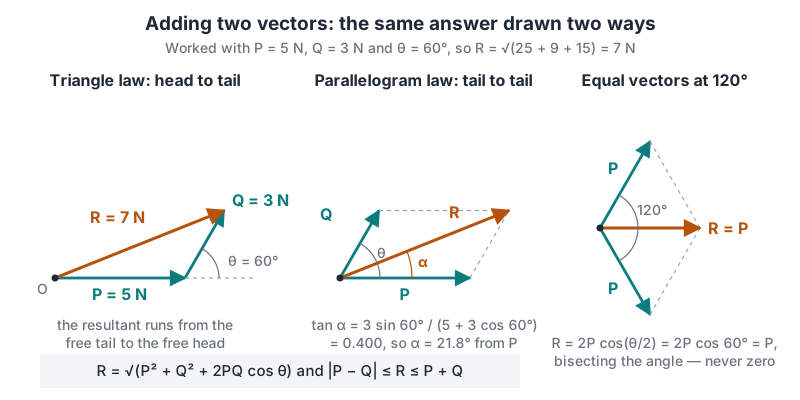
Triangle law. Place the tail of the second on the head of the first; the resultant runs from the free tail to the free head. Polygon law is the same idea for several vectors — if the polygon closes, the resultant is zero, which is exactly the condition for equilibrium.
Parallelogram law. If two vectors P and Q acting at a point are represented by the sides of a parallelogram, the diagonal through that point is the resultant:
R = √(P² + Q² + 2PQ cos θ)
and the resultant makes an angle α with P given by
tan α = Q sin θ / (P + Q cos θ)
where θ is the angle between P and Q, both in the same unit.
Figure 1 Adding two vectors, drawn two ways
The special cases carry most of the marks:
| θ | Resultant R | Note | ||
|---|---|---|---|---|
| 0° | P + Q | Maximum possible | ||
| 60° | √(P² + Q² + PQ) | |||
| 90° | √(P² + Q²) | tan α = Q/P | ||
| 120° with P = Q | P | Neither zero nor 2P | ||
| 180° | ** | P − Q | ** | Minimum possible |
So the resultant of two vectors always lies in the band |P − Q| ≤ R ≤ P + Q. Two consequences that are asked directly: two unequal vectors can never add to zero, and three vectors can add to zero only if each is no larger than the sum of the other two (they must close a triangle).
For two equal vectors of magnitude P at angle θ, the algebra collapses to R = 2P cos(θ/2), and the resultant bisects the angle. At θ = 120° that gives 2P cos 60° = P — the standard trick question.
Subtraction is addition of the negative: A − B = A + (−B), with magnitude √(P² + Q² − 2PQ cos θ). Note that the difference of two equal vectors at 60° is P, while their sum is P√3.
Resolving a vector
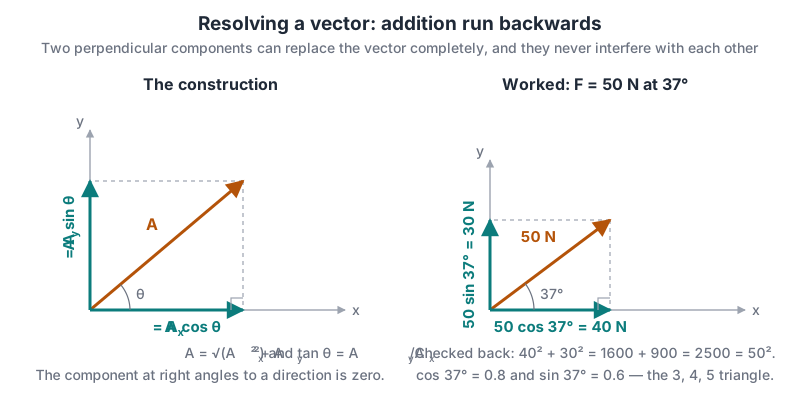
Resolution is addition run backwards, and it is how nearly every numerical in mechanics is actually done. For a vector A at angle θ to the x-axis:
A_x = A cos θ, A_y = A sin θ, A = √(A_x² + A_y²), tan θ = A_y/A_x
Figure 2 Resolving a vector into components
In three dimensions A = A_x î + A_y ĵ + A_z k̂ with magnitude √(A_x² + A_y² + A_z²), and the direction cosines satisfy cos²α + cos²β + cos²γ = 1.
The component of a vector along a direction perpendicular to it is zero — which is why a horizontal force does no work on a body lifted vertically, and why the weight component along a horizontal floor is nothing.
The two products
Scalar (dot) product: A·B = AB cos θ, a scalar.
- Commutative: A·B = B·A. Distributive over addition.
- î·î = ĵ·ĵ = k̂·k̂ = 1 and î·ĵ = ĵ·k̂ = k̂·î = 0, so A·B = A_xB_x + A_yB_y + A_zB_z.
- A·B = 0 for non-zero vectors means they are perpendicular.
- The angle between two vectors: cos θ = (A·B)/(AB).
- Physics: work W = F·s = Fs cos θ; power P = F·v; magnetic flux Φ = B·A.
Vector (cross) product: A × B = AB sin θ n̂, a vector perpendicular to both, its direction given by the right-hand rule.
- Anti-commutative: A × B = −(B × A). Not associative.
- î × î = 0; î × ĵ = k̂, ĵ × k̂ = î, k̂ × î = ĵ (and each reversed gives a minus sign).
- A × B = 0 for non-zero vectors means they are parallel or antiparallel.
- |A × B| is the area of the parallelogram with A and B as sides; half of it is the area of the triangle.
- Physics: torque τ = r × F; angular momentum L = r × p; the magnetic force F = qv × B; linear velocity v = ω × r.
Worked. A = 3î + 4ĵ, B = 4î − 3ĵ. Then A·B = (3)(4) + (4)(−3) = 12 − 12 = 0, so the two are perpendicular. Each has magnitude 5, so |A × B| = 5 × 5 × sin 90° = 25. Checked back by components: A × B = 3(−3)(î × ĵ) + 4(4)(ĵ × î) = −9k̂ − 16k̂ = −25k̂, magnitude 25.
Remember which physical quantity uses which: work is a dot product and torque is a cross product, although both are [ML²T⁻²]. Work is maximum when the force is along the displacement; torque is maximum when the force is perpendicular to the arm.
Relative velocity
The velocity of A as seen by B is
v_AB = v_A − v_B
- Same direction: the relative speed is the difference — two trains at 70 and 50 km h⁻¹ on parallel tracks pass at 20 km h⁻¹.
- Opposite directions: the relative speed is the sum, 120 km h⁻¹.
- At an angle θ: |v_AB| = √(v_A² + v_B² − 2 v_A v_B cos θ).
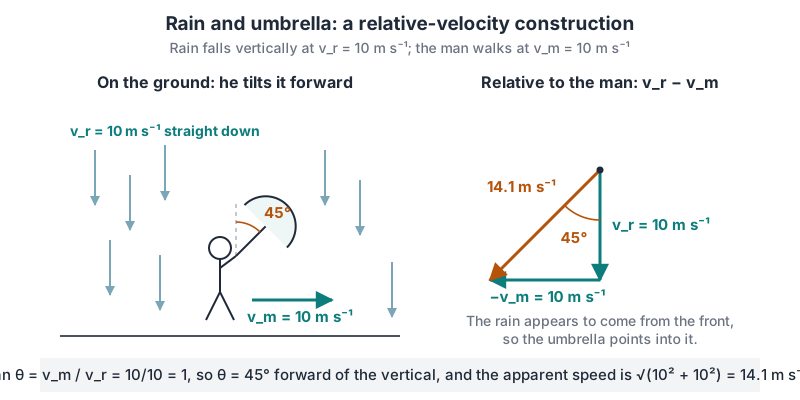
Rain and umbrella. Rain falls vertically at v_r; a man walks horizontally at v_m. Relative to him the rain has velocity v_r downward plus v_m backward, so it appears to come from the front, tilted from the vertical by
tan θ = v_m / v_r
and he must tilt the umbrella forward through that angle. Walk faster and the rain appears to come more nearly horizontally.
Worked. Rain falls vertically at 10 m s⁻¹; the man walks at 10 m s⁻¹. Then tan θ = 1, so θ = 45° forward of the vertical, and the apparent speed is √(10² + 10²) = 14.1 m s⁻¹. Checked back: at 45° the two components must be equal, and they are.
Figure 3 Rain, umbrella and relative velocity
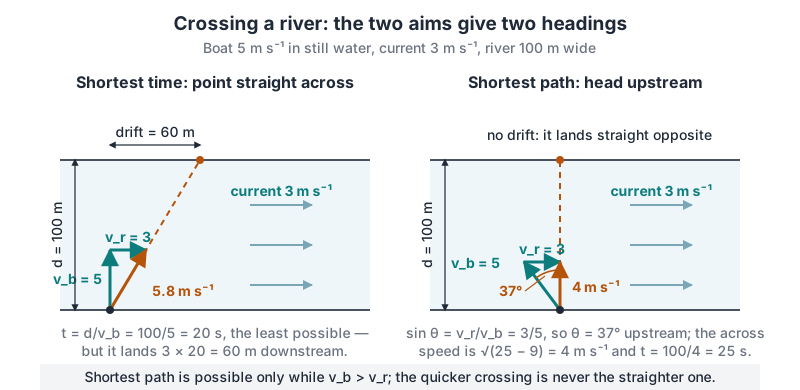
Crossing a river. A boat can do v_b in still water; the current is v_r; the river is d wide.
| Aim | How to steer | Time taken | Extra |
|---|---|---|---|
| Shortest time | Point straight across | t = d/v_b (the least possible) | It lands downstream by a drift v_r·t; ground speed √(v_b² + v_r²) |
| Shortest path | Point upstream at θ from the normal, sin θ = v_r/v_b | t = d/√(v_b² − v_r²) | Possible only if v_b > v_r |
Worked. A river 100 m wide flows at 3 m s⁻¹; a boat does 5 m s⁻¹.
- Shortest time: t = 100/5 = 20 s, drift = 3 × 20 = 60 m downstream.
- Shortest path: effective speed √(25 − 9) = 4 m s⁻¹, so t = 100/4 = 25 s, heading sin θ = 3/5, θ = 37° upstream of the normal.
Checked back: at 37° the across-component is 5 cos 37° = 5 × 0.8 = 4 m s⁻¹ and the along-component is 5 sin 37° = 3 m s⁻¹, which exactly cancels the current — so the boat really does travel straight across at 4 m s⁻¹.
Figure 4 The two ways to cross a river
Numbers and names to memorise
| Item | Value or statement | ||
|---|---|---|---|
| Base units | metre, kilogram, second, ampere, kelvin, mole, candela | ||
| Supplementary units | radian, steradian — both dimensionless | ||
| SI redefinition | 20 May 2019; kilogram now fixed by h | ||
| Least counts | metre rule 1 mm; vernier 0.1 mm; screw gauge 0.01 mm | ||
| Sum or difference | absolute errors add | ||
| Product, quotient, power | relative errors add, each times its power | ||
| Sig figs, + and − | fewest decimal places | ||
| Sig figs, × and ÷ | fewest significant figures | ||
| Force | [MLT⁻²] | ||
| Work, energy, torque | [ML²T⁻²] | ||
| Power | [ML²T⁻³] | ||
| Pressure, stress, modulus | [ML⁻¹T⁻²] | ||
| Momentum and impulse | [MLT⁻¹] | ||
| G | [M⁻¹L³T⁻²] | ||
| h and angular momentum | [ML²T⁻¹] | ||
| Coefficient of viscosity | [ML⁻¹T⁻¹] | ||
| Surface tension | [MT⁻²] | ||
| 1 N | 10⁵ dyne; 1 J = 10⁷ erg | ||
| Resultant of P and Q | R = √(P² + Q² + 2PQ cos θ); tan α = Q sin θ/(P + Q cos θ) | ||
| Two equal vectors P at θ | R = 2P cos(θ/2), bisecting the angle | ||
| Range of a resultant | P − Q | ≤ R ≤ P + Q | |
| Dot and cross | A·B = AB cos θ (scalar); | A × B | = AB sin θ (vector) |
| Shortest river crossing | sin θ = v_r/v_b upstream; t = d/√(v_b² − v_r²) | ||
| Umbrella tilt | tan θ = v_man/v_rain, forward |
Traps
- Precise is not accurate. A zero error makes every reading wrong by the same amount, which is precision without accuracy, and no amount of averaging will save it.
- Errors never cancel. In A − B the absolute errors still add. A difference of two nearly equal measured numbers is the most error-prone thing in a laboratory.
- The power multiplies the error. In ρ = m/l³ the length error counts three times over; students routinely quote 5 % instead of 15 %.
- Dimensional analysis cannot find a number. An option that claims it proves T = 2π√(l/g) exactly is wrong — it gives T = k√(l/g) and stops there.
- Same dimensions, different quantity. Work and torque, pressure and stress and energy density, impulse and momentum, h and angular momentum. A dimensional check can never distinguish them.
- Electric current, pressure and temperature are scalars, however directional they feel. The test is whether they add by the triangle law.
- Two unequal vectors can never give a zero resultant, and the resultant of two equal vectors at 120° is one of them, not zero.
- Angles in the resultant formula are measured between the vectors, tail to tail — not between one vector and the resultant, and not the angle in the figure between a force and a wall.
- Trailing zeros with no decimal point are ambiguous. 4700 m is not automatically four significant figures.
Quick check
0 of 5 answered- 1Which pair of quantities has the same dimensional formula?
- 2The side of a cube is measured as 2.0 ± 0.1 cm. The percentage error in the calculated volume is
- 3Two forces of equal magnitude F act at a point with 120° between them. Their resultant has magnitude
- 4A boat that does 5 m s⁻¹ in still water must cross a 120 m river flowing at 3 m s⁻¹ by the shortest path. The crossing takes
- 5Dimensional analysis of an equation cannot
Sources
- MEC syllabus, third revision (28 April 2026), Physics unit 1 Mechanics, chapter 1 scope points — headings and order.
- Wikipedia (CC BY-SA), read 22 September 2026, paraphrased for definitions and the 2019 figures: SI base unit, 2019 revision of the SI, Metric prefix, Significant figures, Accuracy and precision, Dimensional analysis, Euclidean vector, Cross product, Dot product, Relative velocity.
- NIST reference values for the defining constants (h, e, c) — quoted here to the digits the Grade 11–12 texts use.
- NCERT Class 11 Physics, Units and Measurements and Motion in a Plane — consulted for the error-combination table and the rounding rule taught in Nepal; nothing copied.
- HyperPhysics — consulted as a sanity check on the dimensional formulae table.
- Related reading: Kinematics applies every vector result here to motion, and Mechanics: the complete high-yield map is the one-page formula view of the whole unit.
- Figures: credited in each caption (original diagrams unless a caption says otherwise).
- Every numerical above worked forward and checked back by the author.