In the paper
Unit 1 carries 2 of the 40 botany marks; with two chapters sharing them, this one averages one (MEC publishes weights by unit, not by chapter). The MEC scope line: Structure, types and biological role of carbohydrates; Lipids; Minerals. Three ways it is asked:
- Recall: the monomers of sucrose, lactose and maltose; the linkage in cellulose; the element at the centre of chlorophyll; the micronutrient nitrogenase needs.
- Understanding: why sucrose fails Benedict's test; why humans cannot digest cellulose; why nitrogen deficiency shows on old leaves but iron deficiency on young ones.
- Application: yellowing between green veins on the youngest leaves; an extract that reacts with Benedict's only after acid boiling.
Structure, types and biological role of carbohydrates
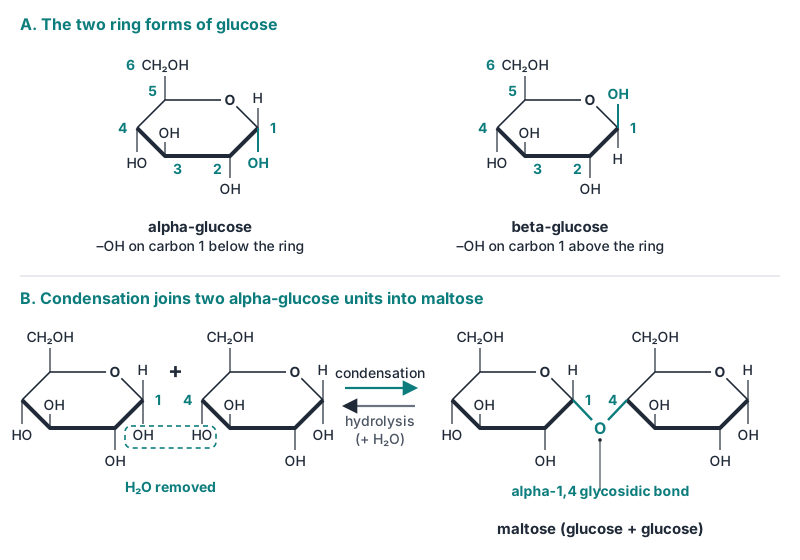
Carbohydrates are polyhydroxy aldehydes or ketones and their polymers, made of C, H and O, most fitting the formula Cn(H2O)n — "hydrates of carbon" (deoxyribose, C₅H₁₀O₄, does not fit). Monomers join by a glycosidic bond, made by removing water (condensation) and broken by adding it back (hydrolysis).
Monosaccharides
Single sugar units: sweet, crystalline, soluble. An aldose carries an aldehyde group (–CHO), a ketose a keto group (C=O).
| Carbons | Name | Examples | Why it matters |
|---|---|---|---|
| 3 | Triose | Glyceraldehyde (aldose), dihydroxyacetone (ketose) | Phosphorylated forms run glycolysis and the Calvin cycle |
| 5 | Pentose | Ribose, deoxyribose, ribulose | RNA, DNA and ATP; ribulose bisphosphate accepts CO₂ in photosynthesis |
| 6 | Hexose | Glucose, galactose (aldoses); fructose (ketose) | Glucose is the main respiratory fuel |
Glucose, fructose and galactose share the formula C₆H₁₂O₆ — they are isomers. In water they close into rings, and the –OH on carbon 1 of glucose can sit below the ring (alpha) or above it (beta). That one difference decides whether a glucose polymer is food (starch) or fibre (cellulose).
Figure 1 Alpha and beta glucose, and maltose by condensation
Disaccharides
| Disaccharide | Monomers | Bond | Reducing? | Where found |
|---|---|---|---|---|
| Sucrose | Glucose + fructose | alpha-1,2 (C1 of glucose to C2 of fructose) | No | Cane sugar; the phloem transport sugar |
| Maltose | Glucose + glucose | alpha-1,4 | Yes | Malt; product of starch digestion by amylase |
| Lactose | Galactose + glucose | beta-1,4 | Yes | Milk |
A reducing sugar has a free aldehyde or keto group that turns blue Benedict's or Fehling's solution to a brick-red precipitate. All monosaccharides are reducing. Sucrose's reducing carbons are locked in its bond, so it is non-reducing until boiling with dilute acid splits it into glucose and fructose.
Polysaccharides
Hundreds to thousands of units; not sweet, mostly insoluble.
| Polysaccharide | Monomer and linkage | Shape | Iodine | Role |
|---|---|---|---|---|
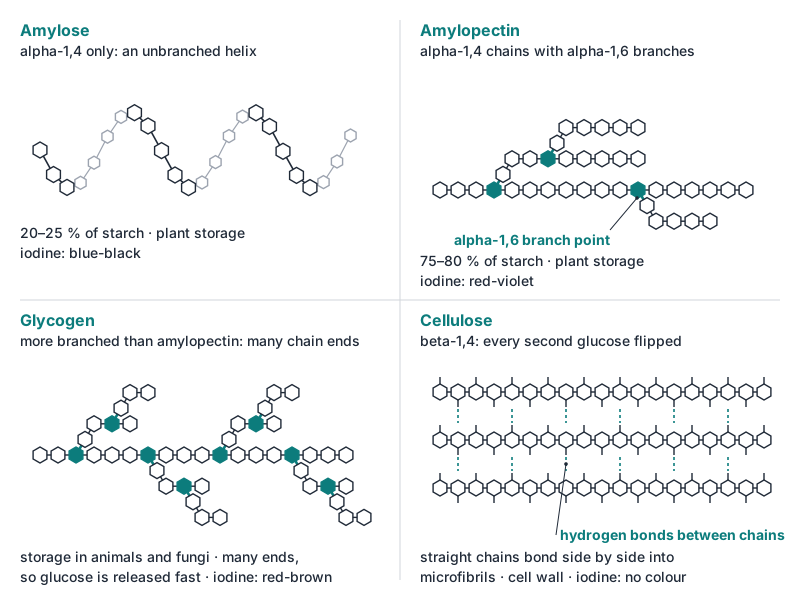
| Amylose (about 20–25 % of starch) | Glucose, alpha-1,4 | Unbranched helix | Blue-black | Plant storage |
| Amylopectin (about 75–80 %) | Glucose, alpha-1,4 with alpha-1,6 branches | Branched | Red-violet | Plant storage |
| Glycogen | Glucose, alpha-1,4 and alpha-1,6 | More branched than amylopectin — many chain ends, so glucose is released fast | Red-brown | Storage in animals and fungi |
| Cellulose | Glucose, beta-1,4 | Straight chains hydrogen-bonded into microfibrils | None | Plant cell wall; the most abundant organic compound on Earth |
| Chitin | N-acetylglucosamine, beta-1,4 | Straight chains | None | Fungal cell wall; insect exoskeleton |
| Inulin | Fructose | Chains | No blue | Storage in dahlia tubers |
Walls also hold hemicellulose and pectin, which as calcium pectate forms the middle lamella.
Why the linkage matters. Amylases fit alpha bonds only. In cellulose every second glucose is flipped, so chains lie straight and bond into tough fibres no human enzyme can split; cattle digest grass only through cellulase-making rumen microbes.
Figure 2 Amylose, amylopectin, glycogen and cellulose compared
Roles: fuel (glucose, about 17 kJ or 4 kcal per gram); storage (starch, glycogen, inulin); structure (cellulose, chitin, pectin); transport (sucrose, which is non-reducing and so travels unchanged); and building blocks (ribose and deoxyribose in nucleic acids and ATP; sugar chains as cell-recognition markers).
Lipids
Lipids are compounds insoluble in water but soluble in organic solvents (ether, chloroform, benzene); most are esters of fatty acids. They hold far less oxygen than carbohydrates and so yield about 37 kJ (9 kcal) per gram — roughly twice as much.
Fatty acids
A hydrocarbon chain ending in a carboxyl group (–COOH), usually with an even number of carbons.
| Saturated | Unsaturated | |
|---|---|---|
| C=C bonds | None | One (monounsaturated) or more (polyunsaturated) |
| Chain | Straight, packs tightly | Cis double bonds kink it |
| At room temperature | Solid — fats | Liquid — oils |
| Examples | Palmitic (C16), stearic (C18) | Oleic (C18, one C=C), linoleic (two), linolenic (three) |
Hydrogenation saturates the double bonds and turns an oil into a solid fat (vegetable ghee), also making harmful trans fats. Linoleic and linolenic acids are essential fatty acids that humans cannot make.
Classes
| Class | Composition | Examples and role |
|---|---|---|
| Simple: fats and oils (triglycerides) | Glycerol + three fatty acids by ester bonds | Energy store in seeds (mustard, groundnut) and fat tissue |
| Simple: waxes | A long-chain fatty acid + a long-chain alcohol (not glycerol) | Leaf and fruit cuticle, beeswax; waterproofing |
| Compound: phospholipids | Glycerol + two fatty acids + a phosphate group (with choline in lecithin) | Amphipathic — hydrophilic head, hydrophobic tails; the bilayer of every membrane |
| Compound: glycolipids, lipoproteins | Lipid + sugar, lipid + protein | Membrane markers; lipid transport in blood |
| Derived: steroids | Four fused carbon rings, no fatty-acid chains | Cholesterol (animal membranes, steroid hormones); phytosterols (plants); ergosterol (fungi) |
| Derived: terpenes | Isoprene (C5) units | Carotenoids, the phytol tail of chlorophyll, gibberellins, rubber, essential oils |
Figure 3 Triglyceride, phospholipid and membrane bilayer
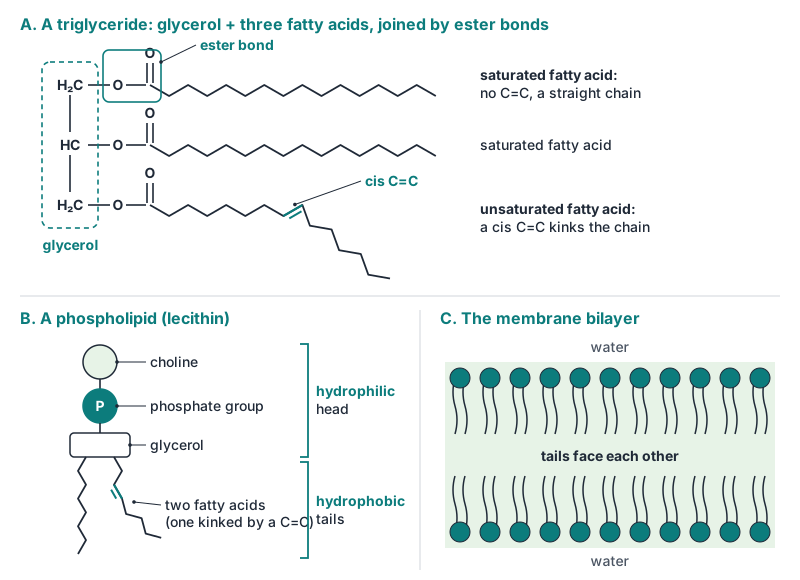
Roles: compact energy stores in seeds; membranes (phospholipid bilayer, with sterols regulating fluidity); waterproofing (the waxy cuticle cuts water loss); steroid hormones and the fat-soluble vitamins A, D, E and K. Tests: Sudan III stains lipid red; a grease spot leaves paper translucent. Boiling a fat with alkali gives glycerol and soap (saponification).
Minerals
Plants absorb minerals as ions dissolved in soil water. An element is essential (Arnon and Stout, 1939) if (1) without it the plant cannot complete its life cycle, (2) no other element can replace it, and (3) it is directly involved in metabolism. Essentiality is tested in hydroponics (soil-free nutrient solution, developed by Sachs and Knop around 1860) by leaving out one element at a time.
How many? The Grade 11 text and NCERT list 17 essential elements, split by the amount needed (NCERT's line is 10 mmol per kg of dry matter):
- Macronutrients (9): C, H, O (from air and water) and N, P, K, Ca, Mg, S.
- Micronutrients (8), or trace elements: Fe, Mn, Cu, Zn, B, Mo, Cl, Ni.
OpenStax Biology 2e counts about 20 because it adds cobalt, sodium and silicon, which are beneficial to some plants. Use 17 in the paper.
Mobility decides where symptoms appear. Mobile elements (N, P, K, Mg) are withdrawn from old leaves and sent to growing ones, so shortage shows first on older, lower leaves. Immobile elements (Ca, S, Fe, B, Cu) stay where first laid down, so young leaves and tips suffer first. Chlorosis is yellowing from lost chlorophyll; necrosis is death of tissue.
| Element | Main roles | Deficiency |
|---|---|---|
| N | Amino acids, proteins, nucleic acids, chlorophyll | Stunting; chlorosis starting in older leaves |
| P | ATP, nucleic acids, phospholipids | Dark or purplish leaves, poor roots, late maturity |
| K | Opens stomata, activates enzymes, ion balance | Scorched margins of older leaves, weak stems that lodge |
| Ca | Calcium pectate of the middle lamella, mitotic spindle, membranes | Death of shoot and root tips; blossom-end rot of tomato |
| Mg | Central atom of chlorophyll; activates RuBisCO and ATP enzymes | Interveinal chlorosis of older leaves |
| S | Cysteine and methionine, coenzyme A, thiamine, biotin | Chlorosis of young leaves |
| Fe | Cytochromes, ferredoxin; needed to make chlorophyll, though not part of it | Interveinal chlorosis of young leaves |
| Mn | Splitting of water in photosynthesis; enzyme activator | Chlorosis with grey spots (grey speck of oats) |
| Zn | Carbonic anhydrase; needed for auxin synthesis | Little leaf, rosetting; khaira disease of rice |
| Cu | Plastocyanin, cytochrome oxidase | Die-back of shoots |
| B | Calcium uptake, pollen germination, sugar movement | Death of tips; brown heart of turnip and swede |
| Mo | Nitrogenase, nitrate reductase | Whiptail of cauliflower; needed in the smallest amount |
| Cl | Splitting of water (with Mn); ion balance | Wilted leaf tips |
| Ni | Urease | Urea builds up and burns leaf tips |
Numbers and names to memorise
| Item | Value |
|---|---|
| Sucrose / maltose / lactose | Glc + Fru, alpha-1,2 / Glc + Glc, alpha-1,4 / Gal + Glc, beta-1,4 |
| Starch | Amylose 20–25 %, amylopectin 75–80 % |
| Branch points (amylopectin, glycogen) | alpha-1,6 |
| Cellulose; chitin | beta-1,4 glucose; beta-1,4 N-acetylglucosamine |
| Energy per gram | Carbohydrate about 17 kJ (4 kcal); fat about 37 kJ (9 kcal) |
| Triglyceride; phospholipid | Glycerol + 3 fatty acids; glycerol + 2 fatty acids + phosphate |
| Essential elements | 17 = 9 macro + 8 micro (Grade 11, NCERT); about 20 in OpenStax |
| Mobile / immobile | N, P, K, Mg / Ca, S, Fe, B, Cu |
| Water splitting | Mn and Cl |
Traps
- Sucrose is non-reducing; maltose and lactose are reducing.
- Starch and cellulose are both glucose polymers; they differ in linkage (alpha versus beta-1,4), not in monomer.
- Glycogen is not a plant store. Plants store starch (and inulin); animals and fungi store glycogen.
- Chitin contains nitrogen; cellulose does not.
- A wax is not a triglyceride: its alcohol is a long-chain alcohol, not glycerol. Steroids contain no fatty acids yet count as lipids by solubility.
- Mg is part of chlorophyll; Fe is not. Both cause chlorosis — Mg on old leaves, Fe on young ones.
- 17 or 20 essential elements? 17 in the Grade 11 text; OpenStax's larger count adds beneficial Co, Na and Si.
Quick check
0 of 5 answered- 1Which sugar gives no brick-red precipitate when boiled directly with Benedict's solution?
- 2Humans digest starch but not cellulose, although both are glucose polymers, because cellulose:
- 3Mustard oil is treated with hydrogen over a nickel catalyst until it sets solid at room temperature. The change was:
- 4In a maize field the youngest leaves show yellow tissue between green veins while older leaves stay green. The most likely deficiency is:
- 5The micronutrient needed by both nitrogenase and nitrate reductase, and required in the smallest amount of all, is:
Sources
- OpenStax, Biology 2e, 3.2 Carbohydrates and 3.3 Lipids (consulted), read 2026-09-15.
- OpenStax, Biology 2e, 31.1 Nutritional Requirements of Plants (Table 31.1 and the macronutrient roles), read 2026-09-15.
- Wikipedia: Plant nutrition (17 elements, mobility, Arnon and Stout 1939, zinc and little leaf), Starch (amylose 20–25 %), Reducing sugar, Glycosidic bond, Hydroponics (Sachs and Knop), read 2026-09-15.
- NCERT Biology Class 11 (2006 edition), ch. 9 Biomolecules and ch. 12 Mineral Nutrition; Nepal CDC Grade 11 Biology — consulted for scope, terminology and the deficiency list.
- Figures: credited in each caption (original diagrams).